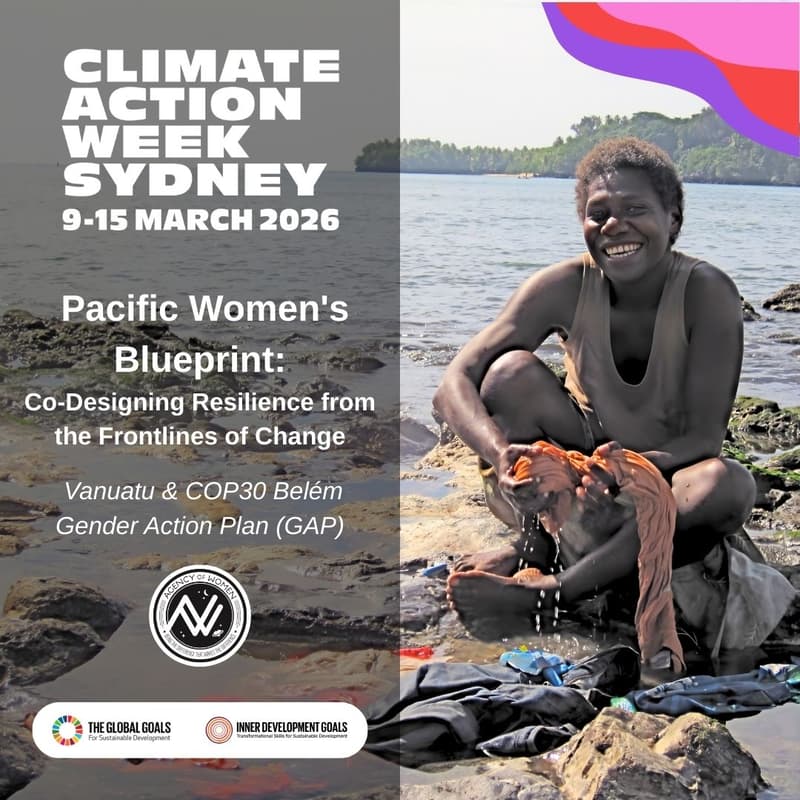

Systems Change in the Pacific: Lessons from Vanuatu’s Frontlines
What does systems change really look like when you live on the frontlines of the climate crisis?
This interactive session dives into a real case study from Vanuatu to explore the messy, relational work of shifting power, practices and narratives in Pacific communities.
Instead of abstract frameworks, we focus on the lived reality: women leading resilience efforts with limited resources, overlapping governance layers, international actors with short funding cycles, and cultural knowledge that doesn’t fit neatly into Western policy templates.
Together, we will map the system around one concrete initiative, surface the hidden dynamics that keep harmful patterns in place, and explore what genuine, Pacific‑led transformation could look like.
Participants will co‑create insights and recommendations that can inform future climate and development policy for the region.
Date: Monday 9 March
Time: 14:00 - 17:30
Location: The Great Hall, University of Technology Sydney, 15 Broadway, Ultimo NSW 2007, Australia
"We gratefully acknowledge that this event is being held on the unceded lands of the Gadigal People of the Eora Nation. To their Elders, past present and emerging, we bring our respect, our hearts and our intentions for learning and deep listening."
What Participants will Learn:
By the end of the session, participants will:
Understand the difference between project‑level change and systems change, grounded in a real Pacific case rather than abstract models.
See how power, culture, gender, funding rules and narratives interact to shape what is possible in places like Vanuatu.
Practice simple systems tools (actor mapping, feedback loops, leverage points) they can reuse in their own work.
Recognise common traps in international climate action (short cycles, top‑down design, “pilotitis”) and identify more respectful, Pacific‑led alternatives.
Develop concrete, context‑sensitive “next moves” that could realistically strengthen systemic resilience in the Pacific.
Session Outline:
1. Welcome & problem framing
Setting the scene: the Pacific as ground zero for climate impacts, but also for innovation and leadership.
Introduction to the Vanuatu case: who is involved, what they’re trying to change, what’s at stake.
Frame the session: we’re not “fixing Vanuatu”; we’re learning how systems change really works in Pacific contexts.
3. Mapping the system together (20 min)
Participants in small groups work with a simple systems map template:
Who are the key actors (local, national, regional, international)?
What flows between them (money, information, authority, trust)?
Which rules/norms shape decisions (kastom, church, law, donor criteria, gender roles)?
Groups identify 2–3 reinforcing loops (“vicious” or “virtuous” cycles) that either trap communities or support resilience.
4. Seeing leverage points & power (15 min)
Whole‑room harvest: what patterns are emerging across the maps?
Short input: leverage points for systems change (mindsets, narratives, rules, power, resource flows).
In groups:
Where are the current interventions actually landing (projects, trainings, infrastructure)?
Where should we be intervening if we want durable change (e.g. local women’s leadership, land tenure, funding rules)?
5. Designing “next moves” that respect context (15 min)
Same groups draft 2–3 “next moves” that:
Are led or co‑led by Pacific actors.
Work with existing cultural and governance structures instead of bypassing them.
Could realistically be funded or supported in the next 1–3 years.
Each move includes: what changes, who leads, who must be convinced, and how success would be felt locally.
6. From room to policy – sense‑making & commitments (15 min)
Facilitators cluster the “next moves” and insights into themes (e.g. funding rules, data and evidence, gender and leadership, regional coordination).
Quick reflection:
“If a Pacific policymaker or donor official were in the room, what 3 messages would you want them to hear?”
“What will you do differently in your own role as a result of this?”
Our goal is to bring the disparity of understanding into clear focus. By contrasting our best strategic thinking with Mary’s lived reality, we will identify exactly where global support mechanisms fail to land - and design new bridges that actually connect.
How the outputs can inform policy
Outputs from the co-design lab will be synthesised into "The Sydney Statement on Pacific-Led Climate Resilience and Adaptive Leadership".
30 March 2026: Formalisation as a policy document.
15 April 2026: Delivery to DFAT, Pacific High Commissions, and the UNFCCC Gender Secretariat.
June 2026: Formal submission to the Pre-COP31 Pacific hosting framework.
Speakers & Hosts:
Maria (Polly) Cutmore (Acknowledgement of Country): Gamilaraay/Wiriyaraay/Anaiwan/Ngarabul Cultural Woman & Elder from the Plains and Tablelands of Northern NSW
Mary Jack (Keynote/Provocateur): Architect of the Mitingar Blueprint, Vanuatu.
Wendy Harper: Founder, Agency of Women (Host).
Dr Leila Alem: Adjunct Professor UTS - Systems transformation
Milly Thomas: International environmental lawyer and pro bono lawyer at DLA Piper LLP
Heidi Dumesich: Sustainability Manager - Transport and Defence & Social Infrastructure (D&SI) at Ventia and co-host of Bula COP31
Miia Burrow: Climate Change Specialist - Climate Resilient Communities Support Unit / Funded by Australian Government. Implemented by DT Global
Bianca McNeair: Malgana Traditional Owner from Gathaagudu Shark Bay WA, CoChair of the National First People’s Platform on Climate Change and advocate for Aboriginal Women caring for Country
Access & Safety:
Accessibility: Fully wheelchair accessible. High-spec AV and professional moderation to ensure virtual attendees have equal participation in co-design sessions.
Safety/Photography: This event will be photographed and filmed for the "Sydney Statement on Pacific-Led Climate Resilience and Adaptive Leadership." Consent is a condition of entry.
Inclusions: Digital Evidence Folder (Mitingar Pilot Design & Baseline Metrics + Belém GAP implementation guide).
Please Note: 100% of profits from ticket proceeds for this event will be donated to the Mitingar Women and Girls Association in Vanuatu to fund Mary Jack's participation and the initial phase of their 3-year organisational infrastructure project. You can find more information about Mitingar and the women of Vanuatu here: https://mitingar-gdg-j1259nv.raiselysite.com/