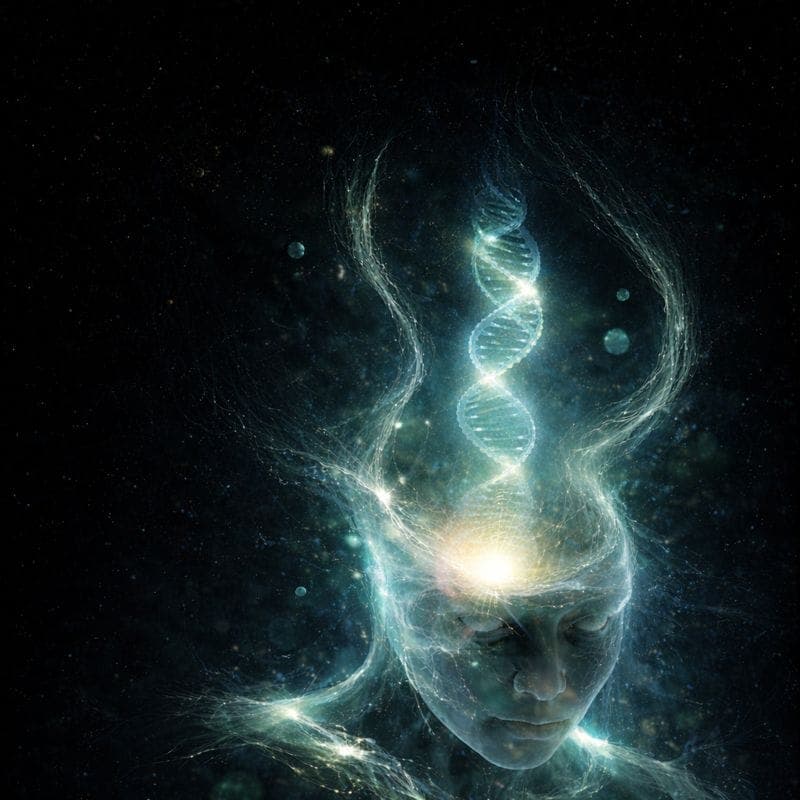

Death? Yes/ No/ Maybe
ahiddenvariable.com
Program is subject to changes.
Sunday March 22, 2026
Necrophone by Mars Vertigo (Cyberdelic Society Berlin)
17:00 - 17:30 "Life, Death, Buddhism and Immortality: Modernity and its Challenges" by Dr. Gleb Sharygin
(20min + Q&A)
The recent scientific and technological advances raise the question of how long and if at all human beings will be subject to ageing and death, and suffer from diseases, mental and physical pain. This prospect has drastic consequences for several traditional spiritual teachings, and perhaps especially for Buddhism, particularly the South and Southeast Asian Buddhist tradition called Theravāda, which has arguably retained the oldest canon of Buddhist texts, often thought to represent the Buddha’s original teachings. In the so-called “First Sermon”, the core Buddhist teaching, the Buddha had first proclaimed the famous Four Noble Truths, the first of which states that there is abundant suffering (dukkha) in the world. In particular, the Buddha designates birth, disease, ageing, and death as the most obvious and prevalent forms of suffering. But what if the AI-assisted technological progress soon stops (at least) the last three of them? Moreover, what kind of Buddhism – and what spiritual teaching in general – will and can be needed in the post-ageing, post-death, post-scarcity, new world of abundance? In this talk, Dr Gleb Sharygin offers a few suggestions, the main of which is that Buddhism, in order to survive in the high technology age, needs to adapt to this new socio-economic and cultural environment, and in doing so must stress and clearly present its nature as a Way of Life, deliberate spiritual exercises for self-improvement and radical self-transformation.
Dr. Gleb Sharygin studied philosophy, religion, psychology of religion and ancient Indian languages at Moscow State University and classical Indology, philology, source criticism, and historiography at the Institute of Oriental Studies (Moscow) and the University of Munich (LMU München). His research interests include the world of thought of early Buddhism, ancient Buddhist canonical literature, ancient Indian contemplative practices and their development, and the interaction and interplay of language, practice and theory that inform and shape Buddhist practice and its concepts. He also works in comparative and cross-cultural philosophy, philosophy of mind and cognitive science.
He has published several papers on Buddhist studies and Indology and given many presentations, some of which are accessible on his academia.edu page.
Currently, he is a Postdoc and Research Fellow at the BSB Munich in the German National Project "Qalamos".
18:00 - 19:00 Beyond the Human Clock: Meaning, Mind, and Life Without an End - Panel talk (40min+Q&A)
Moderator: Dr. Amelia McConville
Speakers: Dr. Gleb Sharygin Dr. Prateep Beed Dr. Jan-Philipp Kruse
If human lives were to extend for centuries, what would become of meaning, identity, and responsibility in a world no longer organized around mortality? This panel explores how radical longevity might reshape our sense of self, creativity, moral accountability, and our relationship to suffering and impermanence. It asks whether the pursuit of immortality represents a new horizon of human possibility or a profound challenge to how we understand life itself.
19:00 Performance by Saaara "Through my hands I contemplate existence"(activation of works by Alejandra Valcárcel)