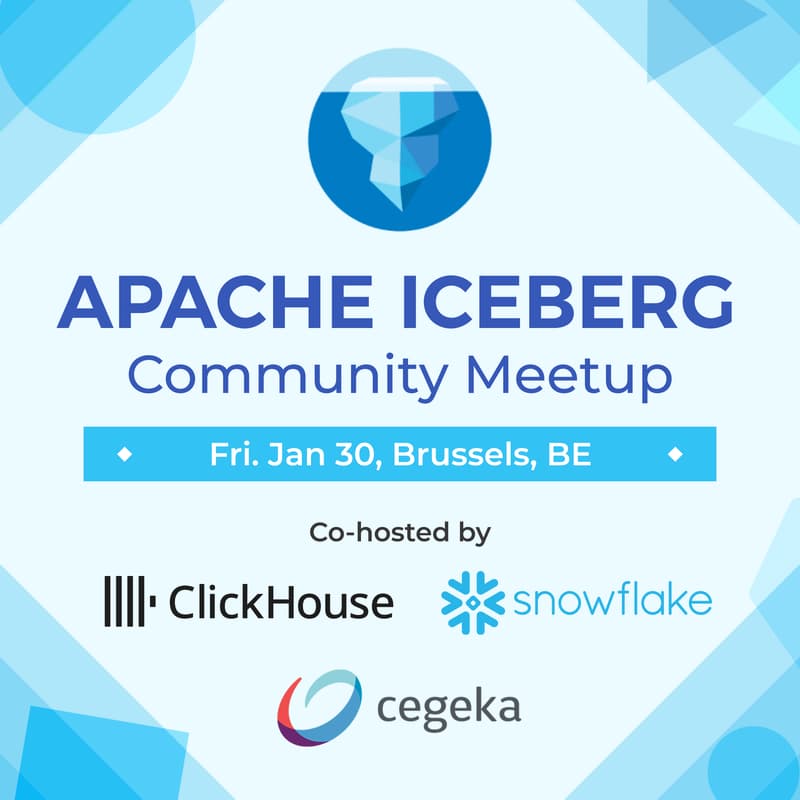

Apache Iceberg™ Meetup Belgium: FOSDEM Edition
Apache Iceberg™ Meetup Belgium: FOSDEM Edition!
Join us on Friday, January 30th from 5:30 PM - 8:30 PM at the Cegeka offices!
We're excited to bring together the open lakehouse community at FOSDEM to learn about Iceberg, connect with fellow enthusiasts, and share insights.
We welcome seasoned Iceberg users, data engineers, students, and more! Everyone has something to learn!
Note: Parking is available at the event! We recommend to park your car at the general parking (see below) and take the bridge or stairs to go to the first floor. Flags and signs will be placed so that attendees can find the office easily.
Agenda
5:30 PM - 6:00 PM: Doors Open & Networking
6:00 PM - 8:00 PM: Welcome Remarks & Presentations!
8:00 PM - 8:30 PM: More Networking
Topic 1: The Rise of Apache Iceberg in Modern Data platforms- By Cegeka
As organizations adopt multiple data platforms, the need for open and interoperable architectures has become essential. Apache Iceberg has emerged as a modern table format that brings reliability, performance, and transactional guarantees to the data lake—while remaining independent of any single engine or vendor.
In this session, we explore how Microsoft Fabric, Snowflake, and Databricks are embracing Apache Iceberg to enable cross-platform interoperability. We’ll discuss how Iceberg allows data to be shared seamlessly across analytics, engineering, and AI workloads, helping teams reduce complexity, avoid lock-in, and build scalable, future-ready data architectures.
Topic 2: Using Transpilation to make Types Safe w/ Apache Spark and Iceberg - By Holden Karau @ Snowflake
As our data "swamps" have gotten cleaned up, using types in our queries is finally becoming a possibility. Unfortunately, Spark is one of the few systems where adding type information can actually cause performance regressions. This talk will look at why the current typed APIs in Spark don't mesh well with pushdowns, and what we can do to fix it (with transpilation). In addition to expanding support for pushdowns from strongly typed Spark, we'll explore how transpilation can also be used to sneakily convert Python code into Spark and Java code (as needed) for performance.
Topic 3: Breaking Down the Iceberg - By Melvyn @ ClickHouse
Apache Iceberg is often described as a table format, but supporting Iceberg in a query engine requires a deep integration across multiple layers of the data stack: Parquet and Avro file formats, JSON metadata, the Iceberg specification itself, and increasingly the Iceberg REST catalog. Each of these layers introduces performance trade-offs and operational complexity that are not always visible at the SQL level. In this session, we will break down what “Iceberg support” really means in practice and show how ClickHouse’s built-in monitoring and system tables can be used to investigate Iceberg and Parquet efficiency. We will walk through concrete examples of how to analyze metadata access, file pruning effectiveness, scan amplification, and query execution behavior when querying Iceberg tables, and discuss what these observations imply for engine design and table layout choices.
Topic 4: Iceberg for Agents - Turning Raw Data Into AI-Ready Context, Andrew Madson @ Fivetran
AI agents fail in production because they're overwhelmed with data but starved for context. LLM models aren’t the problem. The bottleneck is the data stack: fragmented silos, inconsistent definitions, and logic hidden in tribal knowledge. Agents need structured, reliable, and interpretable context—not just data access.
In this session, we'll show how Apache Iceberg becomes the backbone of AI-ready pipelines. You’ll learn how to elevate your Iceberg implementation from a storage format to a live context layer that powers structured retrieval-augmented generation (RAG), schema-aware agents, and autonomous reasoning grounded in truth.
What we’ll cover:
1. Iceberg Foundations for AI - from ACID to Time Travel
2. From Rows to Relationships - The role of the semantic layer
3. Structured RAG in Practice - Fully open source
The session includes a live demo of a fully open-source Structured RAG stack built on Apache Iceberg, featuring semantic query translation, hybrid retrieval, and governed agent reasoning. Expect architecture diagrams, real code, and practical guidance from the field.
About ClickHouse
Established in 2009, ClickHouse leads the industry with its open-source column-oriented database system, driven by the vision of becoming the fastest OLAP database globally. The company empowers users to generate real-time analytical reports through SQL queries, emphasizing speed in managing escalating data volumes.
📚 Get started on ClickHouse Github
💬 Join the ClickHouse Slack Channel
💜 We’re hiring, join our team!
About Snowflake
Snowflake makes enterprise AI easy, efficient and trusted. More than 10,000 companies around the globe, including hundreds of the world’s largest, use Snowflake’s AI Data Cloud to share data, build applications, and power their business with AI. Snowflake provides native support for Apache Iceberg™ and Apache Polaris™ (incubating).
📚 Check out how Snowflake can power your open data lakehouse
📲 Follow Snowflake on LinkedIn & X
🖥 Subscribe to Snowflake Developers YouTube
❄️ Start your 30-day free Snowflake trial which includes $400 worth of free usage