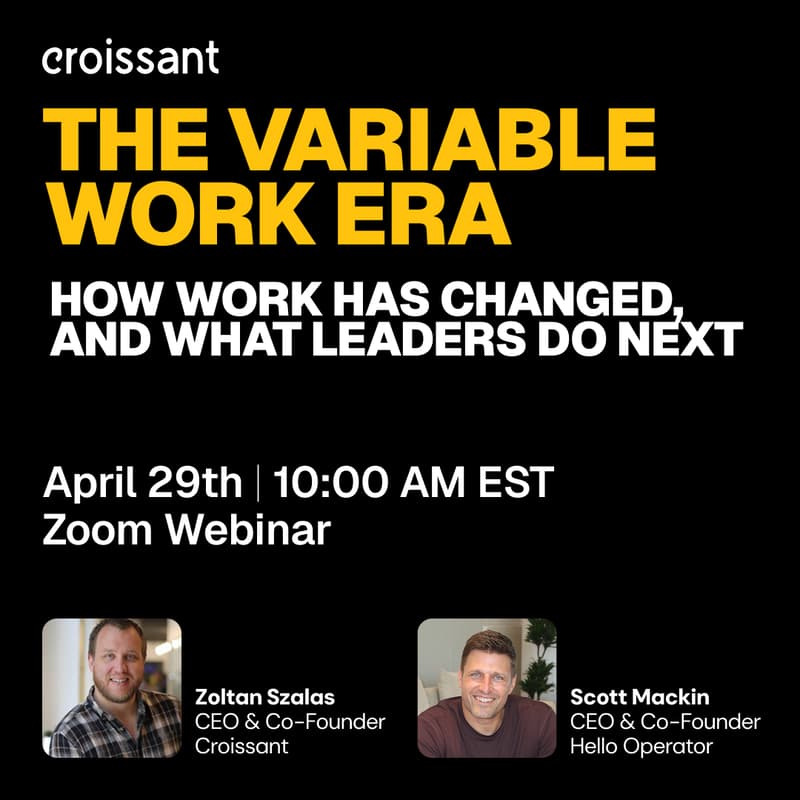

The Workplace Has Become Variable
How do companies design workspace strategy when teams, headcount, budgets, and work patterns are all becoming more fluid?
Work has become more variable. Workplace strategy has not kept up.
Teams are distributed. Headcount plans shift faster. Budgets are under pressure. AI is changing how companies think about talent, productivity, and organizational design.
Yet many companies are still trying to manage workplace strategy with:
Fixed leases
Static policies
Fragmented vendors
Stipends and reimbursements
Outdated assumptions about how people use space
In this 30-minute conversation, Croissant CEO Zoltan Szalas and workplace strategist Scott Mackin will explore why the next era of workplace strategy will be built around flexibility, access, governance, and utilization.
You’ll hear how leading companies are moving beyond the binary debate of “office vs. remote” and toward a more adaptive model for supporting modern teams.
Who should attend
This session is designed for:
CFOs and finance leaders looking for more predictable workspace spend
HR and People leaders shaping hybrid work policies and employee experience
Chiefs of Staff and operators managing distributed teams and changing headcount plans
Facilities and workplace teams rethinking office utilization, access, and vendor complexity
Founders and executives trying to build culture without overcommitting to fixed real estate
What to expect
In 30 minutes, we’ll cover:
Why workplace demand is becoming more variable
How AI, distributed teams, and flexible talent are changing workplace planning
Why fixed office models often fail to match how teams actually work
How to think about workspace as infrastructure, not just a perk
How companies can use access, governance, and utilization data to make better decisions
Agenda
1. The workplace shift
Why teams, budgets, and work patterns are becoming more fluid.
2. The fixed office problem
Why traditional leases and one-size-fits-all policies no longer fit modern companies.
3. The rise of workplace infrastructure
How companies are moving toward flexible access, spend controls, usage intelligence, and vendor consolidation.
4. What leaders should do next
How CFOs, HR leaders, and operators can design a more adaptive workplace strategy.
5. Live Q&A
Audience questions with Zoltan and Scott.
About the hosts
Zoltan Szalas
CEO, Croissant
LinkedIn | Substack
Zoltan leads Croissant’s strategy and vision as the company helps organizations manage the shift from fixed office models to flexible workspace infrastructure.
He is focused on helping companies bring more predictability, control, and intelligence to how they support distributed teams.
Scott Mackin
Founder, HelloOperator.ai
LinkedIn
Scott is an entrepreneur, workplace strategist, and AI marketing advisor. He previously co-founded and scaled a multi-location coworking company across Spain and the UK before its acquisition in 2024.
Today, he works with B2B companies on positioning, thought leadership, and AI-enabled growth strategy.
About Croissant
Croissant helps companies provide flexible workspace access to distributed teams.
Through its global network of coworking spaces, Croissant gives organizations a smarter way to support productivity, collaboration, and connection while improving visibility and control over workspace spend.