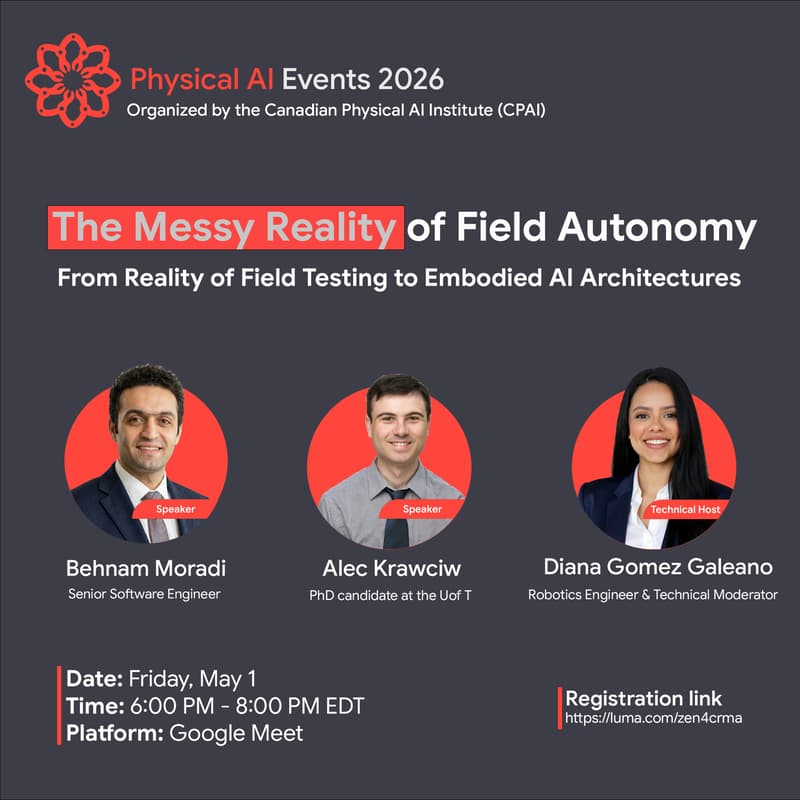

Physical AI: The Messy Reality of Field Autonomy
Are You Building for the Real World, or Just the Benchmark?
While urban driving is a primary focus for both industry and academia, the strict "rules of the road" simplify the navigation problem immensely. When state-of-the-art methods optimized for these predictable environments are taken off-road, the assumption of "absolute determinism" shatters.
Testing in unknown environments exposes critical weaknesses in system design. Whether it is a hard-coded classical architecture failing to adapt to dynamic conditions , or a simple logistics error ruining a week of hardware testing, the transition from simulation to the wild is rarely smooth.
This highly technical session bridges the gap between software architectural evolution and the gritty realities of physical deployment.
What You Will Learn
PART 1 - Driving into the (Un)Known: Perspectives on the Messy Reality of Navigation for Field Robots with Alec Krawciw
Learn why field tests are more often derailed by logistical or unexpected scenarios than by the main area of algorithmic development.
Pre-Field Data Strategies: Learn why developing post-processing tools ahead of the field test is vital. Discover how a simple typo in a ROS message name can prevent critical data from recording, and why running evaluation scripts on-site is a must.
The Logistics of Deployment: Understand why packing is a critical activity: Having the right tools and parts can be the difference between a 10 minute field repair and a drone grounded for a week.
System Failure is Inevitable: Your system will break. Understand the difference between fault prevention and recovery, and why state-of-the-art approaches can completely interrupt a test when they inevitably fail.
Maximizing Field Time: Learn to practice the whole activity (from packing to data evaluation) to reduce your workload during testing so you can actually relax and enjoy the view.
PART 2 - Beyond Hard-Coded Control: The Evolution from Classical State Architectures to Embodied AI in Robotic Autonomy with Behnam Moradi
Explore the theory and mechanisms of the Embodied AI paradigm and why Behavior Trees are a structural improvement, not a cognitive one.
Redefining Safety in Autonomy: Move past the misconception that more code equals more safety. Learn why modern robotics safety relies on probabilistic safety layers and dynamic replanning rather than the massive if-else chains of classical "absolute determinism".
Coding Goal-Seeking Behaviors: Stop viewing uncertainty as a bug to be fixed. Learn to code "goal-seeking behavior" that respects constraints instead of trying to hard-code a specific path for every environmental state.
From Loops to Graphs: Shift your mindset from a linear execution loop ("Who is running now?") to the distributed graph of nodes required in ROS 2 ("What data is available now?").
The True Role of Simulation: Understand that with tools like PX4 and AirSim, you do not test on hardware to see if the software works; you test on hardware to validate that the simulation was accurate.
Agent vs. Controller: Make the architectural leap from building a classical controller that merely regulates a variable to designing an Agent capable of making decisions based on a mission.
Meet Your Speakers
Alec Krawciw
Alec is a fourth-year PhD candidate at the University of Toronto Autonomous Space Robotics Lab and a Vanier Scholar. Holding an undergraduate degree in Mechanical Engineering from the University of Victoria, his work focuses on developing and testing autonomous vehicles in unstructured environments. His field experience ranges from water and snow to lunar analogue environments, and his current PhD research centers on coordinated driving algorithms for Canada's upcoming Lunar Utility Vehicle.
Behnam Moradi
Behnam is a Senior Software Engineer specializing in the architectural evolution of Robotic Autonomy and Embodied AI. Holding a Master's in Control Systems Engineering, his career marks a progression from deterministic control systems to the dynamic, unstructured challenges of autonomous navigation. His current work focuses on moving beyond rigid, hard-coded state machines and Behavior Trees toward priority-driven, mission-oriented agents capable of real-time decision-making in complex environments.
Hosted By: Diana Gomez Galeano
Diana studied Mechanical Engineering at McGill University and previously served as Director of McGill Robotics. She has moderated and hosted numerous technical events, bringing together researchers, engineers, and students to explore the frontiers of emerging technologies, robotics, and Physical AI.
Frequently Asked Questions
Who is this event for?
This session is designed for undergraduate robotics teams, graduate researchers, and industry systems engineers who want to understand the practical challenges of deploying autonomy stacks in the real world.
Is there a Q&A?
Yes! Bring your specific roadblocks and architecture questions. Both Alec and Behnam will be available to answer questions regarding both hardware deployment and software design.