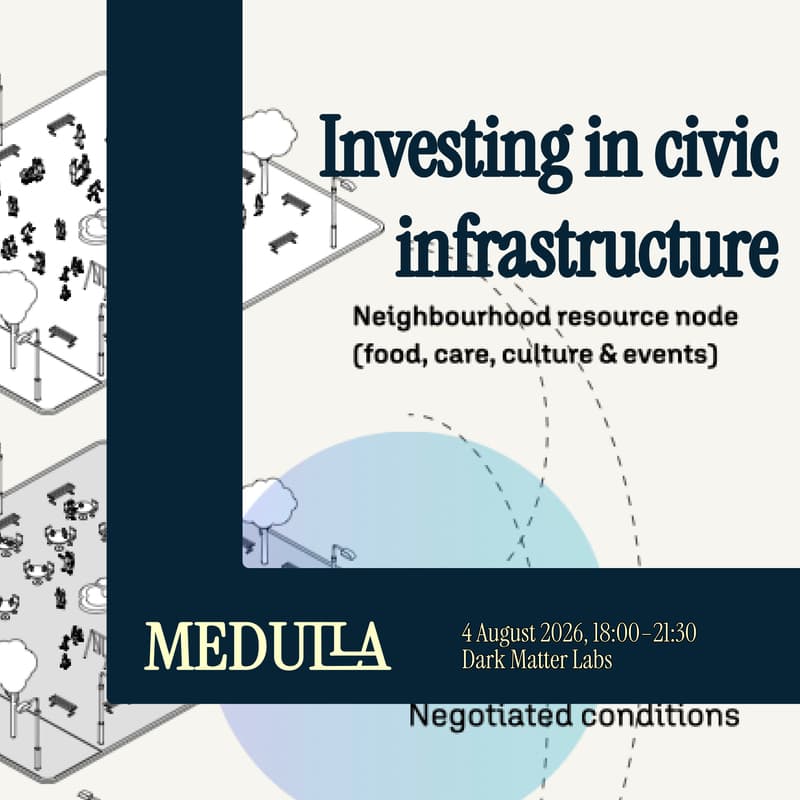


Investing in civic infrastructure
A public evening on permissioning, shared space, and what it takes to keep civic technology alive once the first funding ends.
The problem
Cities build civic technology that works. Systems that book spaces, route permits, and coordinate community use of shared infrastructure. Many of them stop working, and not because the technology failed. Nobody built the structure to keep them alive once the initial funding ended. That is not a Korean problem, a London problem, or a Berlin problem. It is a structural one, and we think it is worth solving together rather than city by city.
The case in front of us
A nightclub in Berlin is world-famous from Friday night to Monday morning. Berlin clubs open at midnight and run until morning, so the floor sits empty every weekday from dawn until the doors open again: roughly 60 hours a week of a large, warm space with a sound system, an open floor, and chairs going unused.
A language exchange group needs somewhere on Tuesday mornings. A youth theatre wants a rehearsal room on Wednesday afternoons. A repair café, a dance course, a community kitchen: the uses are easy to imagine, and the venue owner is open to them.
The gap is not goodwill. It is that no system exists to negotiate a conditional agreement, across different use types, risk profiles, and insurance requirements, at any useful speed. So the space stays empty, and we would like your help changing that.
What we have built so far
Civic Ledger is our attempt to close that gap. Built with Dark Matter Labs and B.Builders across South Korea, London, and Melbourne, it turns plain-language civic requests into structured, conditional agreements that cities and communities negotiate and operate together, with each outcome feeding the next decision.
It has been tested across more than 40 spaces in Incheon, Yongin, and Jeollanam-do. Its R&D funding ends in December 2026, and what comes next is not a technology question. It is a governance, licensing, and sustainability question that every city running public-interest digital infrastructure will eventually meet, and we are bringing our working answers rather than a finished one.
Why Berlin, and why now
We see Berlin as a co-contributor to this question, not its destination. Its new climate adaptation law is live, contested, and short of coordination infrastructure. Its district-level data governance work is active. Its civic-tech ecosystem has its own hard-won experience of what happens when civic agreements break under political pressure.
Who governs civic data, what legal form can hold public-interest infrastructure, how open licensing protects without blocking reuse: these are questions we are working through in South Korea, and questions Berlin is already working through from its own direction. We would like to compare notes.
What this evening is
The first public moment of that exchange. A working conversation, not a product launch. We are looking for people who can help from both sides: funders and investors who want to understand civic infrastructure as an asset class, city actors and commissioners who manage shared space, and practitioners working at the edges of governance, legal design, and public-interest technology.
Come with your objections. We would rather hear where this breaks now than later.
What to expect
Opening framing: why civic infrastructure fails after first funding, and what a shared alternative could look like
A live platform demonstration, working through real cases including the Berlin nightclub above
Discussion of the governance, licensing, and sustainability challenge
Facilitated conversations
Drinks and informal exchange
Speaking
Caroline Paulick-Thiel, Politics for Tomorrow
Indy Johar, Dark Matter Labs
Eunji Kang, Dark Matter Labs
Jaeseung Koo, Civic Ledger and B.Builders
Fang-Raye Chang, Dark Matter Labs
Hosted by Robyn Bennett, Dark Matter Labs
Practical notes
Tuesday 4 August 2026, 18:00–21:15
Medulla, Dresdener Str. 113B, Berlin
Free entry. Donations to support the space are welcome.
Hosted by Dark Matter Labs and Politics for Tomorrow. Part of a week of working sessions in Berlin, 3–7 August 2026.