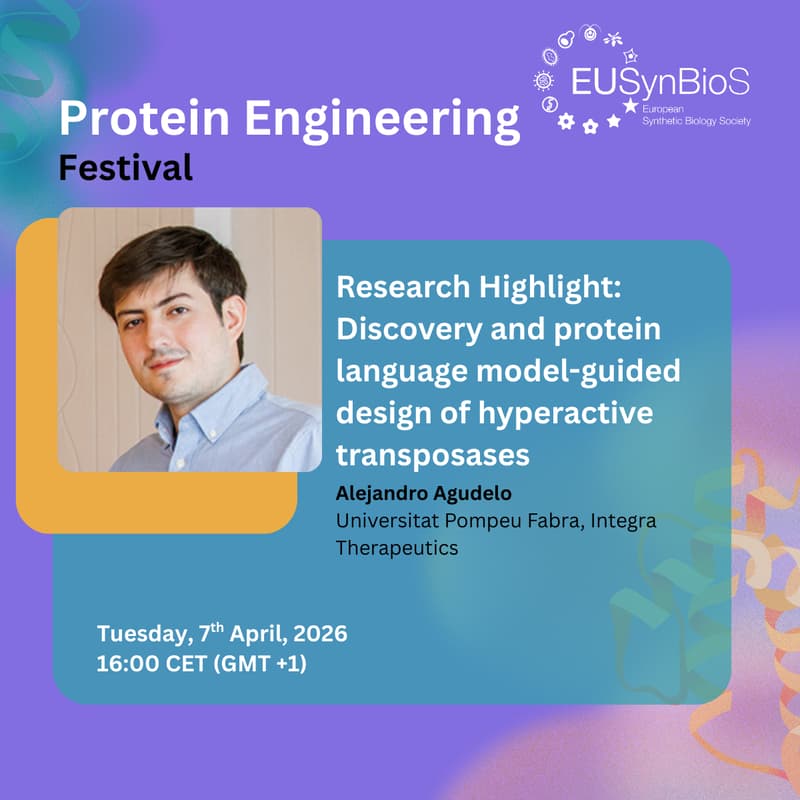

Research Highlight: Discovery and protein language model-guided design of hyperactive transposases
Discovery and protein language model-guided design of hyperactive transposases
Efficient insertion of large DNA sequences into genomes is a key capability for many synthetic biology and gene engineering applications. Among the available tools, PiggyBac transposases have become a powerful platform for gene insertion, but their diversity and biochemical potential remain largely unexplored.
In this work, researchers developed a large-scale eukaryotic transposon mining pipeline to systematically explore PiggyBac diversity across genome databases. This approach expanded the known sequence space of PiggyBac elements by two orders of magnitude and led to the identification of highly divergent transposases. A subset of these candidates was experimentally validated, revealing several active enzymes with diverse sequences and activities.
To further extend this functional landscape, the team fine-tuned a protein language model to generate novel transposase variants beyond naturally occurring sequences. This strategy enabled the discovery of synthetic “hyperactive” transposases with improved activity. Importantly, these enzymes were shown to function in relevant gene-editing contexts, including primary T-cell engineering and Cas9-directed transposase-assisted integration.
Together, this work demonstrates how combining genome mining with AI-driven protein design can rapidly expand the toolkit for genome engineering and synthetic biology.
Speaker Bio
Alejandro Agudelo
Alejandro Agudelo is a PhD student at Integra Therapeutics in Barcelona, where he works on the development of genome engineering technologies. His research focuses on advancing genetic tools for precise DNA integration and expanding the capabilities of transposase-based systems.
Alejandro holds a Master’s degree in Bioinformatics from Universitat Pompeu Fabra (2021–2023) and previously completed a degree in Medicine at Pontificia Universidad Javeriana (2013–2019). His interdisciplinary background in medicine, computational biology, and synthetic biology informs his work at the interface of AI-driven protein engineering and genome editing technologies.