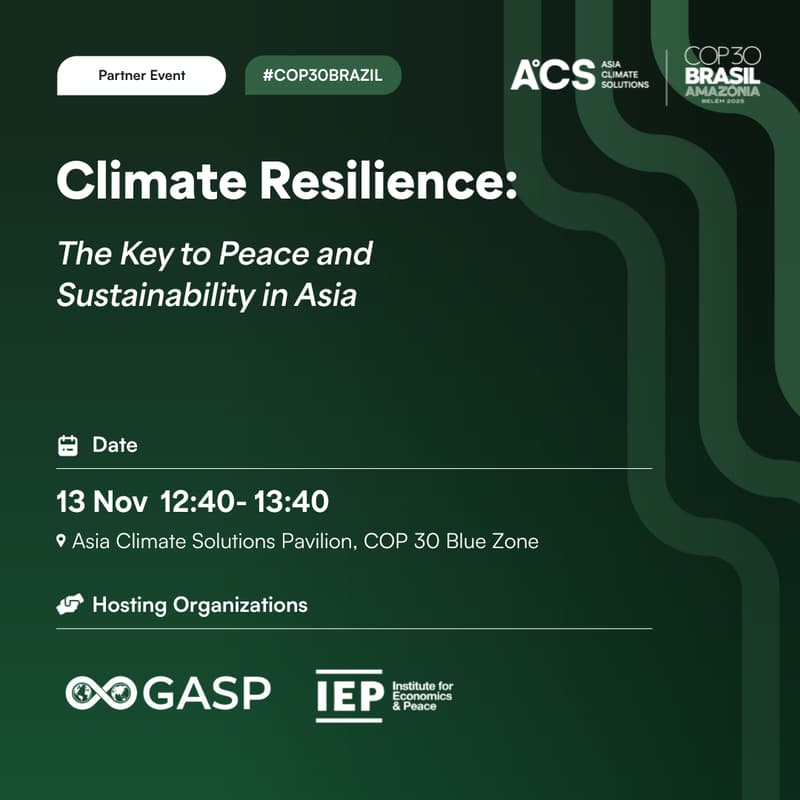

Climate Resilience — The Key to Peace and Sustainability in Asia
Overview
Asia stands at a pivotal crossroads. Home to over half of humanity and many of the world’s fastest-growing economies, the region also faces some of the most acute climate vulnerabilities — from intensified storms and droughts to food, water, and migration pressures that test peace and stability.
The upcoming 2025 Ecological Threat Register (ETR) by the Institute for Economics and Peace (IEP) provides a data-driven understanding of how ecological risks and climate stress are reshaping Asia’s development and security landscape. Yet beyond quantifying threats, this session focuses on where the solutions lie — and how Asia’s innovation, leadership, and cooperation can turn ecological challenges into just, regenerative climate responses.
Across the region, momentum is building for a new model of development that connects environmental security, social justice, and economic opportunity. From investments in clean technology and regenerative agriculture to community-based nature projects that deliver verified climate and livelihood benefits, Asia’s diverse leadership is defining the pathways to peace and sustainability in a changing climate.
This session explores how insights from data, finance, nature-based solutions, and intergenerational diplomacy can work together to strengthen regional and global resilience — ensuring that sustainable growth also delivers stability, equity, and integrity.
Hosts
Global Alliance for a Sustainable Planet (GASP)
Institute for Economics and Peace (IEP)
Session Highlights
Session Focus
This high-level dialogue will explore how climate resilience can be the foundation for peace and sustainable prosperity, uniting perspectives from evidence-based research, sustainable finance, nature-based innovation, and inclusive leadership.
Key themes include:
Turning Ecological Challenges into Just Climate Responses — applying insights from the Ecological Threat Register to shape equitable and effective action.
Building Resilience through Innovation and Nature-Based Solutions — advancing sustainable agriculture, community-led restoration, and low-carbon technologies.
Mobilizing Sustainable Finance with Integrity — aligning capital flows and carbon markets with just transition, ecosystem integrity, and climate security goals.
Intergenerational Climate Diplomacy — ensuring inclusive, youth-led perspectives shape multilateral decision-making and regional cooperation.
Speakers
Opening Remarks and Moderator: Satya S. Tripathi, Secretary-General, Global Alliance for a Sustainable Planet (GASP)
Michael Collins, Executive Director, Americas, Institute for Economics and Peace (IEP) — on ecological threats and peacebuilding insights from the Ecological Threat Register 2025
Noel Lempriere, Vice President, Marketing and Business Development, Clean Seed Capital Group — on agricultural innovation and technological resilience
Mitch Reznick, Head of Sustainable Fixed Income, Federated Hermes Limited — on mobilizing sustainable finance for just and resilient transitions
Keith Bohannon, CEO, Plan Vivo Foundation — on the role of high-integrity nature-based solutions and community-led finance in building equitable resilience
Veena Balakrishnan, Co-Founder and Director of Institutional Relations, Youth Negotiators Academy (YNA) — on intergenerational diplomacy and inclusive governance