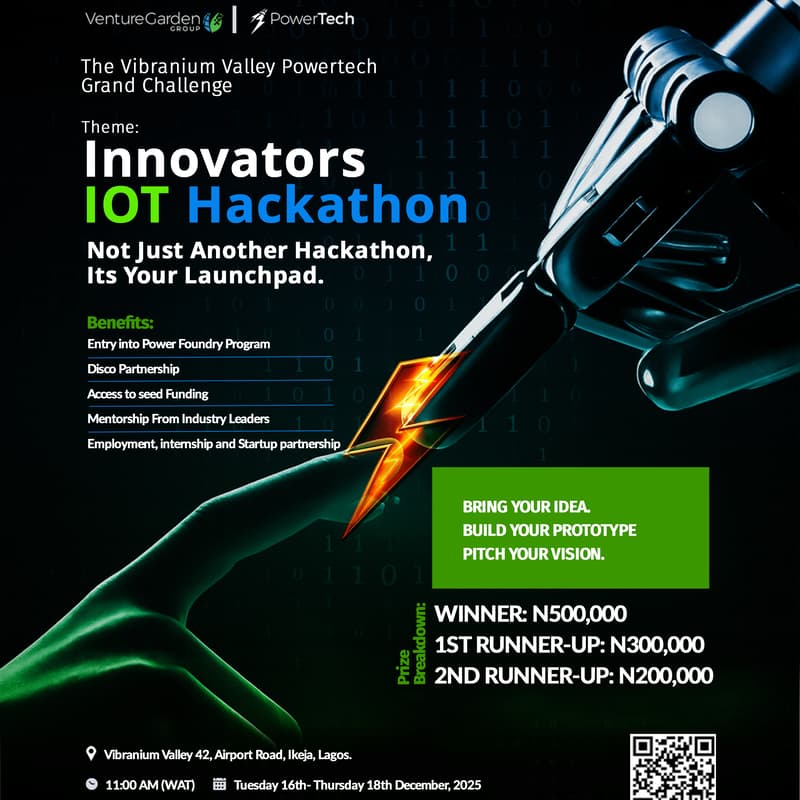

Vibranium Valley X PowerTech Grand Challenge
PowerTech Remote Recharge Grand Challenge
Nigeria’s IoT × Energy Hackathon
Nigeria still relies on millions of prepaid electricity meters that require users to manually type 20-digit tokens to recharge power. Even when electricity is purchased online, the meter itself remains offline, fragmented, and vendor-locked.
This hackathon exists to change that.
The PowerTech Remote Recharge Grand Challenge is a 3-day, in-person IoT and systems engineering hackathon focused on one ambitious goal:
Build a meter-agnostic remote recharge system that works with existing prepaid meters — no keypad, no manual tokens, no meter replacement.
Participants will prototype components of a Meter-Agnostic Remote Recharge Gateway (MARRG) — a national infrastructure layer capable of remotely delivering electricity credit into any STS-based prepaid meter in Nigeria, regardless of manufacturer.
This is not a demo-app hackathon.
It’s a deep, infrastructure-level challenge spanning hardware, cloud systems, AI, and real-world deployment.
The Challenge
Nigeria’s prepaid meter ecosystem is complex and fragmented:
Multiple meter manufacturers (Mojec, Conlog, Hexing, Secure, Momas, etc.)
Different STS protocol implementations
Manual keypad entry still required for most households
Fragmented DISCO backend systems
Inconsistent connectivity (GPRS, NB-IoT, PLC)
Legacy meters expected to remain in use for 12–20 more years
The innovation is not a new meter.
The innovation is a unified national layer that can:
Interface with any existing prepaid meter
Deliver tokens remotely into the meter automatically
Bypass physical keypad limitations via hardware or software bridges
Integrate with DISCO vending engines
Expose APIs for fintechs, banks, and telcos
Enable smart behaviour for “dumb” meters
Who Should Attend
This hackathon is for serious builders and systems thinkers, including:
Hardware & embedded engineers
IoT & connectivity specialists
Cloud / backend engineers
AI & data engineers
Electrical & power systems engineers
Product, strategy, and commercial leads
You can apply solo or as a team. Multidisciplinary teams are strongly encouraged.
Tracks
All teams work toward the same system, through different specialisations:
Track A — Hardware Edge Devices
Universal adapters, clip-ons, retrofit modules, or keypad-bypass mechanisms that interface with legacy meters.
Track B — Cloud Software & Token Orchestration
Unified STS engines, vending APIs, secure token delivery, retry logic, dashboards, and integrations.
Track C — AI & Meter Intelligence
Failure detection, tamper analysis, load prediction, optimization, and revenue-leakage prevention.
Track D — Field Simulation & Commercial Model
Deployment strategy across millions of meters, DISCO integration, pricing models, and national scalability.
3-Day Flow
Day 1 — National Problem Briefing & Team Formation
Participants are onboarded into the real Nigerian prepaid-meter landscape through keynotes and technical briefings from PowerTech, DISCO engineers, STS experts, and ecosystem partners.
Teams form around skillsets and tracks, refine problem focus, and align on architecture and build plans.
Day 2 — Build the Impossible
A full sprint day dedicated to prototyping.
Teams build hardware simulations or devices, cloud APIs, AI layers, and deployment models with hands-on mentor support from energy, fintech, and systems experts.
By the end of Day 2, each team should have a functional prototype or realistic simulation and a clear demo narrative.
Day 3 — Demo, Publish & Compete
Teams present live demos to a judging panel drawn from the PowerTech ecosystem.
Each team shares:
A working prototype or simulation
System architecture
Meter-agnostic strategy
Token delivery flow
Commercial or deployment model
Winners are selected based on feasibility, scalability, cost efficiency, meter compatibility, and real-world deployment potential.
What Happens After
Winning teams enter the PowerTech Foundry Program, a 90-day post-hackathon pathway that includes:
Micro-grants and follow-on funding
Integration with a DISCO partner
Field pilots in real estates
Access to meter OEMs and PowerTech partners
Support toward commercialization, licensing, or acquisition
This is how prototypes become national infrastructure.
Why This Hackathon Is Different
Focused on a single, high-impact national problem
Infrastructure-level, not hype-driven
Designed for real deployment, not slideware
Backed by ecosystem players who can ship pilots
Built to scale across millions of users
Bring your tools. Build the impossible. Power a nation.