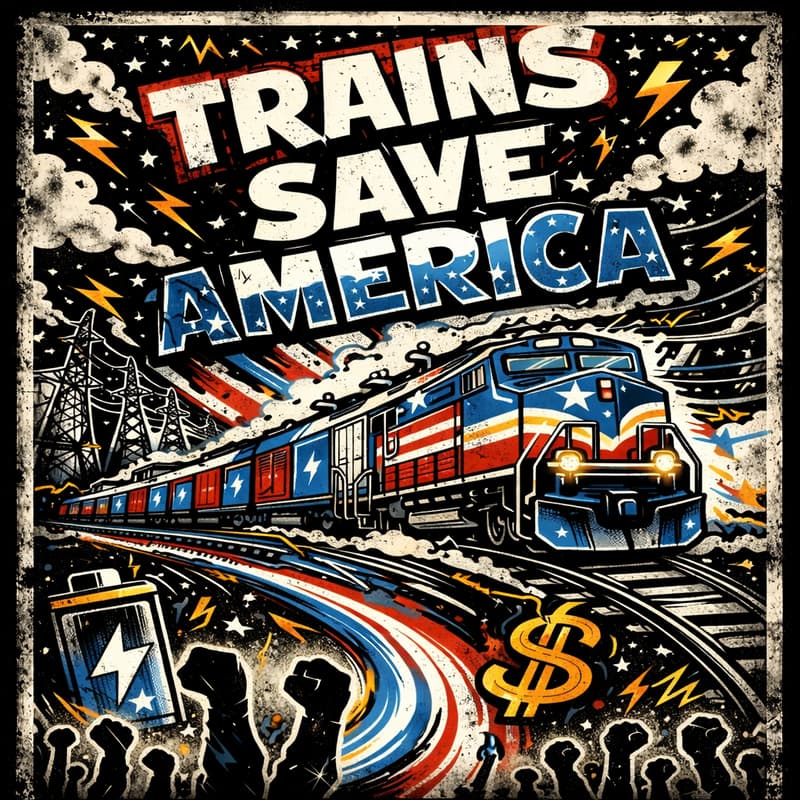
How Railroads Solve the Energy Crisis
MOVING STORED ELECTRICITY OVER THE EXISTING FREIGHT RAILROADS SOLVES THE ENERGY CRISIS!
Come experience a high-voltage lecture on the history of US energy consumption, the historic role of the railroads, the rise of the electrical grid with its modern limitation and the bold company that is changing everything.
Energy generation isn't the issue, it's lacking transmission.
We’ll show how replacing coal trains with electricity trains can break today’s transmission bottleneck, restore balance to the grid, and reopen the path for mass deployment of utility-scale renewable energy across the United States.
Hosted by IBEW Electrical Union Member and Renewable Energy Developer - Christopher Smith
Functioning Model Railroad on Display
Technology Discussion + Q&A Session
Free Coffee + Drinks + Pizza
In the peak era of U.S. coal power, from the early 1950s through 2005, the nation’s railroads functioned as rolling conveyor belts. Hundreds of coal trains operated daily between thousands of coal mines to the coal-fired power plants that supplied roughly half of America’s annual grid electricity. In aggregate, coal trains moved on the order of 6.5 billion pounds of coal to power plants each day. Depending on the type of coal and power plant efficiency, the railroad’s daily flow of coal is equivalent to roughly 5 to 7 TWh of grid electricity, carried by up to 220 coal trains per day nationwide.
Since 2005, the final year of peak coal consumption, annual U.S. electricity generation has plateaued at 4,300 terawatt-hours. As the vast quantity of energy once moved outside the grid by coal trains disappeared, pressure shifted back onto the electric transmission system, contributing to a present day 300,000-mile shortfall in transmission capacity.