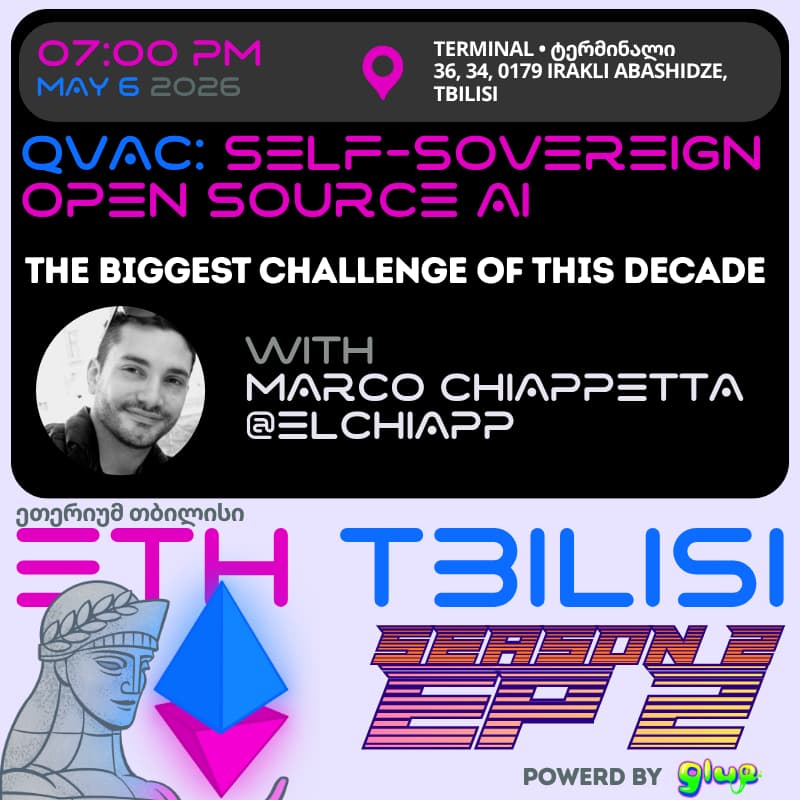
QVAC: Self-Sovereign Open Source AI, the biggest challenge of this decade - ETH Tbilisi 2.2
Your AI Doesn't Belong to You. Here's How to Fix That. 🔥
Every time you use ChatGPT, Gemini, or Claude, your prompts, your data, your thoughts travel to a data center owned by someone else. A corporation decides what you can ask. A terms of service agreement decides what happens to your input. A centralized server decides if the service even stays online.
You don't own your AI. You rent it. And the landlord can change the rules whenever they want.
This is the default today: closed-source models, gated APIs, usage limits, content filters decided by committees you'll never meet, and a kill switch that sits in someone else's hands. Your most intimate questions, your business logic, your creative process, all of it routed through infrastructure you don't control and can't audit.
Now imagine the opposite. AI that runs on your phone. On your laptop. Offline, if you want. No API keys. No data leaving your device. No one between you and your own intelligence. Open-source, peer-to-peer, and unstoppable.
That's what QVAC is building.
QVAC is Tether's open-source AI platform, and it represents a fundamentally different philosophy: intelligence is not a service to rent, it's a resource to own. Built on a local-first, peer-to-peer architecture, QVAC lets developers run LLMs, speech-to-text, translation, vision, and more directly on consumer hardware across every major operating system, from a single codebase. No cloud dependency. No central point of failure. No gatekeeper.
The SDK launched in April 2026 and is already fully open-source on GitHub. It supports text generation, embeddings, multimodal inputs, OCR, and delegated inference through peer-to-peer swarms. Models are distributed through the Holepunch protocol stack, the same decentralized infrastructure behind Keet. AI agents built on QVAC can even transact autonomously using Bitcoin and USDt through Tether's Wallet Development Kit.
Why This Matters for the Agent Economy
Ethereum is building the infrastructure for autonomous AI agents. ERC-8004 gives agents on-chain identity, reputation, and validation through three registries, making them discoverable and trustable across organizational boundaries without pre-existing trust.
But here's the problem nobody talks about: what's the point of giving an agent an on-chain identity if you can't verify what the agent is actually doing?
If your agent's brain runs on a closed-source cloud, its on-chain identity is just a label on a black box.
Open-source, local AI fixes this. When the model is open, the code is auditable, and the inference runs on hardware you control, the on-chain identity actually means something. ERC-8004's reputation and validation registries become meaningful because you can verify not just who the agent claims to be, but what it's actually computing.
This is the full stack of self-sovereign AI: QVAC for the brain and ERC-8004 for the identity
The Event 🎙️
Join Marco Chiappetta from Tether's QVAC team for a deep dive into open-source AI, self-sovereign intelligence, and why the centralized AI model is a dead end. We'll explore the technical architecture behind QVAC, the philosophy driving it, and what it means for developers, users, and the emerging agent economy on Ethereum.
The discussion will be accessible for newcomers yet technical enough for developers. You don't need to write code to understand why AI sovereignty matters. You just need to care about who controls the tools you use every day.
Venue: Terminal • ტერმინალი - Open in Google Maps
The Speaker 🧑💻
Marco Chiappetta — Software developer building QVAC at Tether. CS background with deep experience in backend infrastructure and distributed systems. Now working on Tether's open-source local AI platform, turning the vision of self-sovereign intelligence into working code. X: elchiapp
From QVAC by Tether (@qvac) — an open-source, cross-platform AI framework for building local-first, peer-to-peer AI applications. QVAC supports LLMs, speech, vision, translation, and more, running on any device without cloud dependency. https://qvac.tether.io | qvac
What You'll Walk Away With 🧠
Why centralized AI is architecturally, economically, and philosophically broken How open-source, local-first AI changes the power dynamics between users and platforms What QVAC is, how its SDK works, and how developers can start building with it today Why KYC-ing an AI agent on a closed-source cloud is meaningless without verifiable computation How ERC-8004, x402, and open-source AI form the full stack for self-sovereign agents Where this intersects with Ethereum, DeFi, and the emerging agent economy
How It Works 🛠️
Show up — no technical background required, just curiosity
Learn — understand the problem and the solution from the people building it
Ask questions — open discussion, nothing off limits
Connect — meet the Ethereum community in Tbilisi
Go Deeper 📚
QVAC SDK: https://qvac.tether.io
GitHub: tetherto/qvac
Docs: https://docs.qvac.tether.io
ERC-8004 Spec: https://eips.ethereum.org/EIPS/eip-8004
Ethereum Aligned
ETH Tbilisi is building an active Ethereum community in Georgia through monthly meetups, technical talks, educational resources, debates, and hackathons. Whether you're a developer, designer, student, entrepreneur, or just Ethereum-curious — everyone is welcome. Let's build the Ethereum community in Tbilisi together.
Website: https://ethtbilisi.ge Telegram: https://t.me/ethtbilisi X: ethtbilisi
Supported By 🤝
ETH Tbilisi is made possible thanks to:
Glue — A new DeFi primitive to transform any Token and NFT into a "Digital Asset Treasury" glue.finance | @glue_fi
Interested in sponsoring ETH Tbilisi? Contact us to support Georgia's Ethereum community.