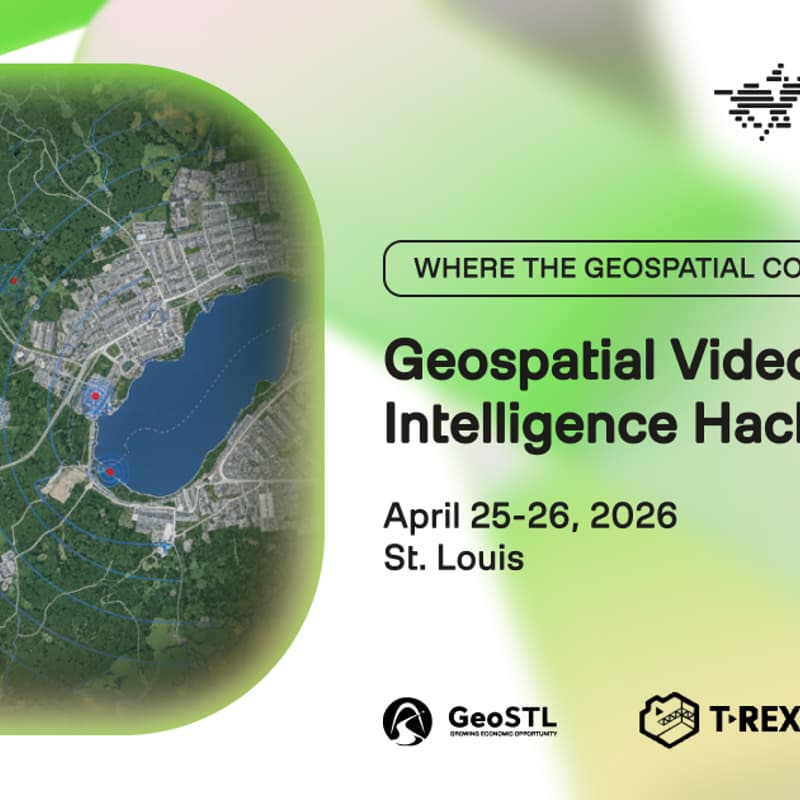
Geospatial Video Intelligence Hackathon
Build Video Intelligence for the World's Most Critical Geospatial Workflows
Join industry developers and university researchers for an intensive weekend of building production-ready video understanding systems for geospatial intelligence. Come solve the technical challenges that define modern geospatial operations: automated mapping, infrastructure monitoring, and multi-source intelligence at scale.
Why St. Louis: You are building in the epicenter of American geospatial intelligence: home to NGA's new $1.75B West campus and the nation's densest concentration of geospatial expertise. The systems you build this weekend could inform how satellites, drones, and ground sensors generate actionable intelligence.
Why Now: Most geospatial data exists as video (satellite feeds, aerial reconnaissance, surveillance streams), yet 90% of it remains manually analyzed or underutilized. Video foundation models purpose-built for spatio-temporal reasoning change that equation. This hackathon explores what's possible when video understanding meets geospatial workflows.
The Challenge: Four Tracks, Real Problems
Choose your track and build solutions that address actual production bottlenecks faced by defense contractors, energy companies, and geospatial operators:
🗺️ Track 1: Geospatial AI for Automated Mapping (Detailed Challenge)
Transform how feature extraction and mapping happens at scale:
Automated Quality Assurance for Open Spatial Data: Build video-powered validation systems that detect map errors, data breakage, and discrepancies in open geospatial datasets. Using Overture Maps Foundation's open map data as the authoritative reference layer, identify and surface mismatches between video-derived observations and the existing base layers—at machine speed, across the kinds of coverage gaps and stale records that manual review would take weeks to catch.
Spatial Data Enrichment using GeoAI: Automate the enrichment of open geospatial data using street-level and low-altitude aerial video to extract feature attributes at scale. For Overture Maps Foundation's sponsored track, two priority focus areas: (1) detect and extract business signage, names, and branding from video to validate and enrich Overture's existing Places data; (2) detect sidewalk presence, width, and condition to build out Overture's pedestrian network layer, benchmarking video-based extraction accuracy against still-imagery baselines to quantify the value of temporal context.
Multimodal Positional Accuracy: Automatically identify and geolocate map features from street level video to cross-reference against OpenStreetMap and Overture Maps data to generate positional accuracy assessments (RMSE, CE90).
Real-world application: NGA's director warned the agency would need 8 million analysts to manually process its growing geospatial data; yet 70% of the planet remains insufficiently mapped, and the military's open-source Releasable Basemap Tiles are only as current as their crowd-sourced inputs. Automated video AI can extract road conditions, infrastructure status, and building features invisible to satellites, closing the mapping gap 48x faster than human analysts at a fraction of the cost.
Sponsored by Overture Maps Foundation: All technical solutions and derived data from this track must be released as open data or open IP (software license: Apache 2.0, data license: CDLA 2.0). Overture's open map data will serve as the reference layer for validation.
⚡ Track 2: Energy Infrastructure Monitoring (Detailed Challenge)
Build intelligent systems for critical infrastructure analysis:
Drone-Based Pipeline Analysis: Process drone footage of oil, gas, and utility infrastructure to detect anomalies, assess condition, and identify maintenance needs; thereby automatically flagging potential failures before they occur
Utility Network Inspection: Analyze overhead power line video for equipment damage, vegetation encroachment, and compliance with safety standards; thereby generating timestamped inspection reports
Agent Workflow Integration: Combine video analysis with structured data (maintenance logs, sensor readings, regulatory requirements) to create comprehensive infrastructure health assessments
Real-world application: Energy companies fly thousands of drone hours annually but lack systems to process footage at scale. Automated analysis could reduce infrastructure inspection costs by 60-80% while improving detection accuracy.
🔗 Track 3: Multimodal Geospatial Workloads (Detailed Challenge)
Process video alongside other intelligence sources:
Video + Structured Data Fusion: Combine video analysis with CSV/database records to correlate visual observations with operational data; identifying patterns invisible in single-source analysis
Video + Document Intelligence: Merge video footage analysis with PDF reports, satellite imagery, and text intelligence to create comprehensive situational awareness products
Multi-Source Intelligence Applications: Build systems that synthesize video, geospatial databases, and unstructured text to answer complex analytical questions
Real-world application: Intelligence analysts spend hours manually correlating data from different sources. Multimodal systems could surface connections in minutes, enabling faster decision-making in time-sensitive situations.
🏭 Track 4: Advanced Manufacturing (Detailed Challenge)
Non-public sector applications with geospatial components:
Construction Site Monitoring: Analyze video from construction sites to track equipment deployment, detect safety violations, and verify progress against plans; generating automated compliance reports
Industrial Equipment Detection: Process facility video to identify specific tools, machinery, and personnel positions for safety monitoring and operational efficiency
Real-world application: Boeing and other advanced manufacturers spend significant resources on manual video review for quality control and safety compliance. Automated systems could reduce review time by 75% while improving detection rates.
What You're Working With
Technology Stack
TwelveLabs Video Foundation Models:
Marengo 3.0: Multimodal embeddings for semantic video search—find moments based on visual content, dialogue, actions, or context without manual tagging
Pegasus 1.5: Video language model for summaries, reports, chapters, and structured intelligence outputs
Available on Amazon Bedrock
TwelveLabs API Documentation →
Sample Datasets That Can Be Considered:
Drone footage of infrastructure and pipelines
Aerial surveillance video from urban environments
Satellite video feeds with temporal progression
Construction site monitoring footage
Manufacturing floor operation videos
Dataset Resources:
We encourage participants to search the AWS opendata registry, Humanitarian Data Exchange (HDX), Overture data, OpenStreetMap static data or API queries to overpass, USGS EarthExplorer, mapillary, openaerialmap, kaggle datasets, roboflow datasets, and huggingface datasets.
Specific Satellite Imagery data on AWS OpenData:
Mentorship from Assured Consulting Solutions
Assured Consulting Solutions provides extensive experience partnering with Federal Government agencies to solve complex technology, information, security, and data challenges.
Founded in 2011 and headquartered in Reston, Virginia, ACS provides the services, technical talent, and market insight necessary to define and execute effective Strategic Support and Advanced Technology solutions.
ACS supports customers across multiple CONUS locations including full coverage in the National Capitol Region and support across the United States.
ACS delivers the expertise and thought leadership required for successful project definition, end-to-end delivery, and management across Strategic Support and Advanced Technology life cycle areas of requirements analysis, design, information assurance and cyber security, implementation, testing, deployment, and transition to operations.
Prizes & Recognition
Top teams will receive:
Cash prizes for 1st, 2nd, and 3rd place overall
1st Place: $1,500
2nd Place: $1,000
3rd Place: $750
Extended TwelveLabs API credits for continued development
Recognition from GeoSTL and partner organizations
Judging Panel: Your solutions will be evaluated by:
✅ Jeffrey Harrison and Thomas Boggess from US Army
✅ Sean Batir from Amazon Web Services (AWS)
✅ Sean Gorman from Zephr.xyz (on behalf of Overture Maps Foundation)
✅ Gizelle Costa from University of Missouri-Saint Louis
✅ Trung Tran, PhD, GISP from Fayetteville State University
✅ Simon Bailey from T-Kartor
✅ Vikram Lakhwara from Stakehouse
✅ Andrew McDowell from HII
✅ Jessica Anabor from Space Generation Advisory Council
✅ Chaz Mason from Assured Consulting Solutions
✅ Mark Munsell from GeoSTL
✅ Michael Jones from TwelveLabs
Event Details
📅 When: April 25-26, 2026 (Weekend)
📍 Where: T-REX Geospatial Innovation Center, Downtown St. Louis (39 N 10th St, St. Louis, MO 63101)
⏰ Schedule:
Saturday, April 25
9:00 AM - Venue Opens: Registration & Breakfast
The T-Rex Geospatial Innovation Center opens for participant check-in and continental breakfast.
Arrive early to meet other participants, set up your workspace, and test network connectivity.
10:00 AM - Opening Keynote & Challenge Introductions
The event officially begins with opening remarks from TwelveLabs, GeoSTL, and sponsor representatives.
This session provides context on why video understanding matters for geospatial intelligence and introduces the business problems that each challenge track addresses.
10:30 AM - Team Formation Session
Participants without pre-formed teams will have the opportunity to introduce themselves, share their technical backgrounds, and discuss preferred challenge tracks.
Teams of two to four people are optimal for hackathon collaboration. Participants arriving with existing teams can use this time to finalize their technical approach and begin environment setup.
11:00 AM: Hacking Begins
Teams begin work on their chosen challenge tracks.
We recommend teams spend the first hour reviewing challenge requirements, scoping their approach, and setting up development environments before diving into implementation.
12:00 PM: Lunch Provided
2:00 PM - Technical Workshop Block (Attend Relevant Sessions)
The Saturday afternoon program provides hands-on technical enablement across four 30-minute workshop sessions.
Each workshop includes live demonstrations and time for questions.
4:00 PM - Hacking Resumes (Full Focus)
All workshops conclude and participants return to full-time development work.
Use the technical knowledge from workshops to refine your implementation approach or troubleshoot integration issues.
6:00 PM - Venue Closes (All Participants Must Exit)
The T-Rex facility closes for the evening. All participants must leave the venue by 6:00 PM per facility security requirements.
Teams are encouraged to continue collaboration remotely if desired
Sunday, April 26
9:00 AM - Venue Opens: Breakfast & Final Development Sprint
The venue reopens for the final day of development. Continental breakfast is available as teams enter the last sprint toward the 1:00 PM submission deadline.
This is the time for focused implementation, testing, and preparation of demonstration materials.
12:00 PM: Lunch Provided
1:00 PM: Submissions Due (Hard Deadline)
Submission requirements include a working demonstration (deployed system accessible via URL or video recording), technical documentation (architecture, implementation approach, GitHub repository), validation report (quantitative metrics and evaluation), and mission impact brief (one-page operational value summary).
2:00 PM: Project Presentations to Judging Panel
Teams present their solutions to the judging panel in order determined by submission timestamp. The presentation format is structured: each team has 10 minutes total including setup time and judge questions.
Judges will evaluate solutions using detailed rubrics specific to each challenge track.
5:00 PM - Judging Deliberation (Closed Session)
After all presentations conclude, judges convene for deliberation to discuss submissions and reach consensus on top teams.
This is a closed session where judges score solutions independently using the provided rubrics, then discuss their assessments to identify the top three teams overall.
5:30 PM - Awards Ceremony & Closing Reception
The organizing team announces the top three winning teams and distributes prizes. Each winning team will have the opportunity to briefly address the audience (2 minutes) to share their approach and learnings.
The closing reception provides an opportunity to celebrate the weekend's accomplishments, connect with judges and sponsors about potential pilot opportunities, and provide feedback to the organizing team.
6:00 PM - Venue Closes
The event officially concludes and the T-Rex facility closes for the evening.
The organizing team will remain available via email for follow-up questions, project showcasing opportunities, or discussions about continuing development of hackathon prototypes.
🎯 Format: In-person collaboration with mentor support
👥 Expected Participation: 40-50 developers and researchers
🍕 Provided: All meals, snacks, beverages, and late-night fuel
Who Should Apply
This event targets two distinct but complementary communities:
Defense Professionals
This is your opportunity to explore cutting-edge video intelligence capabilities for mission-critical workflows. Build prototypes that could inform actual program requirements and deployments.
University Researchers & Students
Washington University, Saint Louis University, and other regional students: This is serious technical work with meaningful outcomes. Parents expecting ROI on tuition? This is how you demonstrate it.
Common Ground: Both audiences share a commitment to technical excellence and understanding that geospatial intelligence requires precision, not approximation.
Why the T-REX Innovation Center?
The T-REX facility was purpose-built for this kind of collaboration. Located in downtown St. Louis with the National Geospatial-Intelligence Agency campus just miles away, it's where the geospatial community gathers to solve hard problems. GeoSTL manages the space specifically to advance St. Louis as the global center for geospatial technology.
Facility Features:
High-speed networking and compute infrastructure
Collaboration spaces designed for intensive development
Proximity to NGA and geospatial contractor offices
On-site technical support and security
GeoSTL Partnership: This event is organized with the nonprofit dedicated to bringing geospatial jobs, innovation, and workforce development to the St. Louis region.
Application Process
Space is limited to 40-50 participants to ensure high-quality collaboration and mentorship.
Applications will be reviewed on a rolling basis (early applications receive priority consideration).
What we're looking for:
Technical experience with video processing, geospatial analysis, or ML/AI systems
Understanding of production challenges in mapping, infrastructure monitoring, or intelligence workflows
Ability to build functional prototypes in 24 hours
Interest in deploying solutions at enterprise scale
Team formation encouraged (2-4 people per team optimal)
Application Requirements:
Brief technical background (200 words)
Preferred challenge track(s)
GitHub profile or portfolio link (optional but helpful)
Team members if pre-formed (teams can also form at the event)
Registration Deadline: April 24, 2026
Frequently Asked Questions
Can I participate remotely?
No. This is an in-person event designed for intensive collaboration. Remote participation reduces the quality of mentorship and team dynamics that make these events valuable.
What if I don't have a team?
Perfectly fine. Many participants arrive individually and form teams during the Saturday morning session. We facilitate team formation based on track interests and complementary skills.
Are meals provided?
Yes. Breakfast and lunch on Saturday and Sunday are included. Dietary restrictions will be accommodated.
Can I work on multiple tracks?
You can explore multiple tracks, but final submissions should focus on one track for judging purposes. Depth beats breadth.
Contact
Event Organizer: James Le, TwelveLabs Developer Experience (james@twelvelabs.io)
Venue & Logistics: Kathleen Klein, T-Rex Innovation Center (kathleen@downtowntrex.org)
GeoSTL Partnership: Molly Brady, Director of Engagement and Policy (molly@geostl.ai)
This is your opportunity to build the geospatial intelligence infrastructure that could power operations for the next decade. See you in St. Louis.