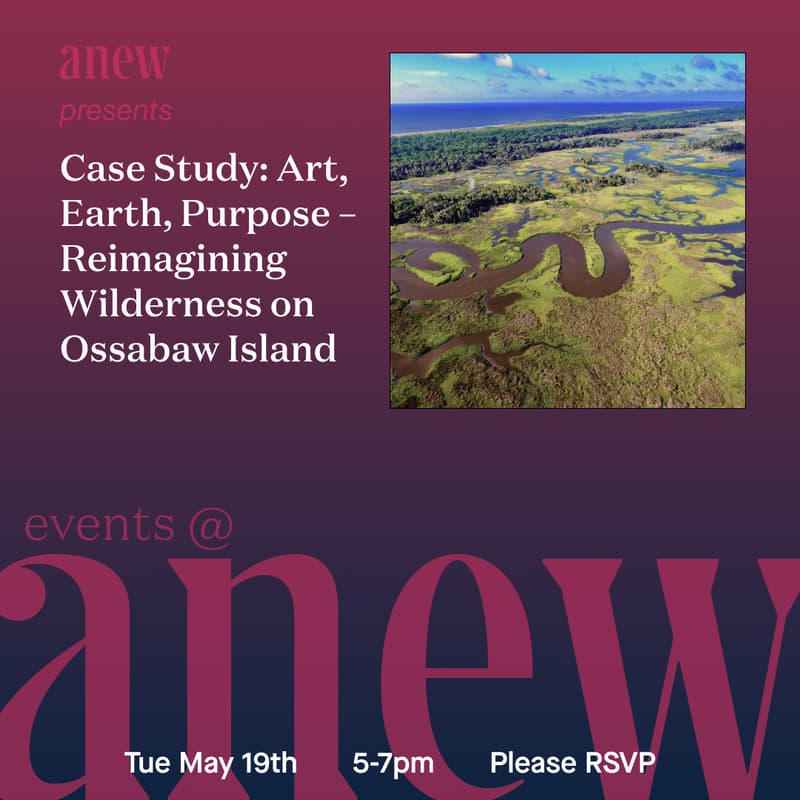

Case Study: Art, Earth, Purpose – Reimagining Wilderness on Ossabaw Island
We are in desperate need of new ways to relate to our environment as we grapple with deforestation, rising sea levels, and the disappearance of wilderness. What if there was a place that centered contemplation rather than exploitation as a way for humans to relate to the land around them? Could that type of environment lead to new pathways of creative, scientific, and intellectual flourishing?
We’re excited to explore a real world case study of such a place: Ossabaw, a massive but little-known island off the coast of Georgia. Miraculously, this undeveloped island has been preserved as an “ecological workshop for human creativity,” offering proof that humans can simultaneously help the earth heal and inspire boundless ideas and purpose. When Eleanor “Sandy” Torrey West inherited the island after her mother’s passing in 1958, she made it her lifelong mission to protect Ossabaw. In 1961, she and her husband invited an eclectic group of artists, scientists, businesspeople, religious leaders, scholars, intellectuals, and writers to a residency program that they dubbed the ‘Ossabaw Island Project.’ The program ran for twenty-one years with zero expectations from its participants except to attune to the wisdom the island offered. West and her family eventually sold the island to the State of Georgia in 1978 under a novel arrangement that ensured it would only be used for “natural, scientific, and cultural study, research, and education, and environmentally sound preservation, conservation, and management of the Island’s ecosystem.” Decades later, thanks to this pioneering feat of environmentalism, Ossabaw remains undeveloped, visited only (and rarely) by outside researchers and scholars under the auspices of a non-profit known as the Ossabaw Island Foundation.
What can the history of this place teach us about protecting our Earth when it needs it most? What would it mean to shift our relationship to the land around us from ownership to stewardship? What can we learn from the people who passed through Ossabaw Island about the possibilities of nature when it is allowed to evolve and thrive as it sees fit?
For this Spotlight, we’ll host a discussion between Beryl Gilothwest, Sandy West’s grandson and the co-editor of the new book Off the Coast of Paradise: Artists and Ossabaw Island, 1961–Now, and Megan Mayhew Bergman, a contributor to the publication and the director of a new short film about Sandy West’s ecofeminist legacy. The conversation will be preceded by the inaugural screening of Mayhew Bergman’s short film, “A Taste of the Wild: The Legacy of Sandy West.”
Please let us know if you can make it.
Beryl Gilothwest is a curator, writer, and art historian based in New York. He is the Deputy Director of Research and Exhibitions at the Calder Foundation and has contributed to exhibition catalogues and publications, including Apartamento, The Brooklyn Rail, and Art in America. He is the co-editor and co-curator of Off the Coast of Paradise: Artists and Ossabaw Island, 1961–Now, which is on view at Telfair Museums' Jepson Center in Savannah until September 6th.
Megan Mayhew Bergman is an award-winning fiction writer, conservation journalist, filmmaker, and cultural critic. She serves as Director of Creative Writing at Middlebury College and Director of the Bread Loaf Environmental Writers’ Conference. She is the author of four books and her work has appeared in The New Yorker, The New York Times, The Guardian, The Paris Review, Harper’s Bazaar, and elsewhere
Anew is a gathering space and discovery center for the social impact community.