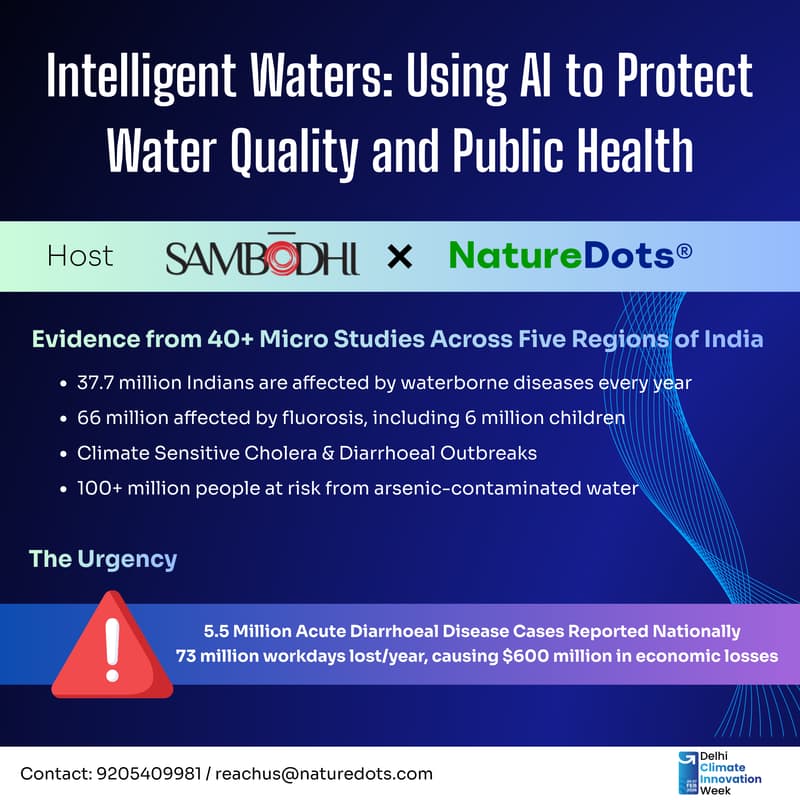

Intelligent Waters: Using AI to Protect Water Quality and Public Health
Water is the primary systems variable through which environmental, economic, and public health risks materialize. While climate change amplifies hydrological volatility, the underlying structural challenge lies in fragmented water governance, inadequate real-time data, declining groundwater reserves, deteriorating water quality, and insufficient integration between water systems and sectoral planning.
This roundtable brings together experts from public health, water management, and deep tech to examine how artificial intelligence can strengthen water quality surveillance and disease prevention in India. Grounded in evidence from 38 micro-level studies (2014–2025) and national surveillance data, the discussion will address persistent waterborne health risks driven by microbial contamination, geogenic and industrial pollutants, climate variability, and systemic inequities.
Participants will explore how AI-enabled tools such as predictive analytics, real-time sensor data, geospatial modeling, and early-warning systems—can enhance region-specific monitoring beyond conventional TDS metrics. The roundtable will focus on translating complex contamination patterns (including E. coli, fluoride, arsenic, uranium, and industrial pollutants) into actionable public health insights, particularly for vulnerable populations such as children, rural and tribal communities, and peri-urban residents. Emphasis will be placed on integrating AI into laboratory networks, surveillance systems, and intersectoral decision-making to improve water safety, resilience, and long-term public health outcomes.