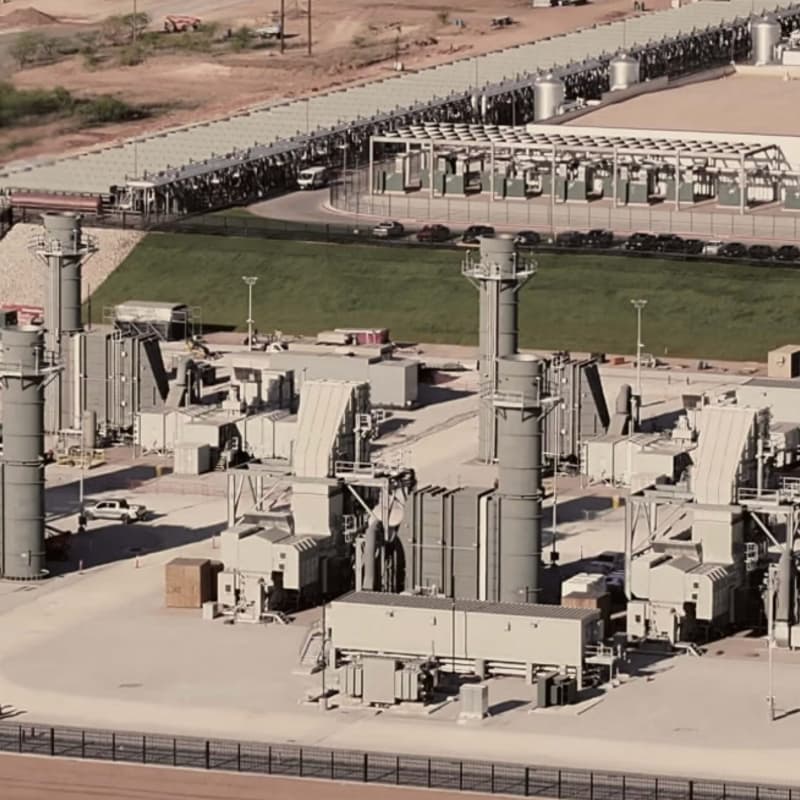

The AI Gas Rush: Risks and Implications of "Bring Your Own Power”
Join us on Thursday, November 5th at 3:30 PM EST for a webinar discussing the risks of “bring your own power” (BYOP) strategies for AI data centers. Report authors will be discussing their new report on the impacts and risks of BYOP, the current policy landscape, and policy principles to ensure communities and the environment are protected. There will be time for discussion, so review the report early and bring your questions.
Report summary:
As you all know well, while the President, governors, lawmakers and regulators are increasingly encouraging and incentivizing Big Tech and AI data center developers to secure and finance their own power generation, billion-dollar companies are taking the opportunity to sidestep laws and regulations meant to protect consumers, the environment and climate so they can begin powering their enormous data centers as quickly as possible.
Building on work from Global Energy Monitor, the Environmental Integrity Project, and Cleanview, we estimate that gas will power approximately 80% of energy generation from BYOP projects coming online in the next five years. In total, we identify 177 GW of planned gas capacity, equivalent to 23% of the entire U.S.’s peak demand in 2025 and enough to power 65% of all U.S. homes. If built, nine proposed gas BYOP projects will become among the top 10 largest power plants in the U.S.
Our new report: The AI Gas Rush: Risks and Implications of "Bring Your Own Power", contains analysis of all proposed BYOP projects, including behind-the-meter and other arrangements, an analysis of state BYOP related policies passed to date, and an analysis of the specific types of gas generators proposed–over half of which are less efficient and more polluting gas generators than typical gas power plants. Finally, the report contains a set of policy principals as well as community intervention points specifically relevant to addressing BYOP projects.
Speaker Bios:
Callie Rabinovitz
Callie Rabinovitz (She/her) is a Research and Policy Analyst on the Clean Energy Team at Earthjustice, based out of NYC. Her work focuses on the environmental and grid impacts of data centers, as well as the broader legal and regulatory environment.
John Bangsund
John Bangsund is an interdisciplinary research scientist focused on energy, the environment, and health. His experience spans multiple labs and startups, including work on solar cells, rapid pathogen detection, and emissions modeling. Since 2025, he has worked with the Better Data Center Project studying emissions from energy and backup power at data centers. He holds a PhD in Materials Science from the University of Minnesota.
Catherine Casomar
Catherine Casomar is a co-founder of the Better Data Center Project, an organization formed by former federal workers in 2025 to provide technical assistance to communities on the front lines of data center development. She has 15 years of experience in energy and climate and a decade of work advancing equity and justice across sectors. Catherine holds a PhD in Materials Science from the University of Minnesota and a BSE in Mechanical and Aerospace Engineering from Princeton University.