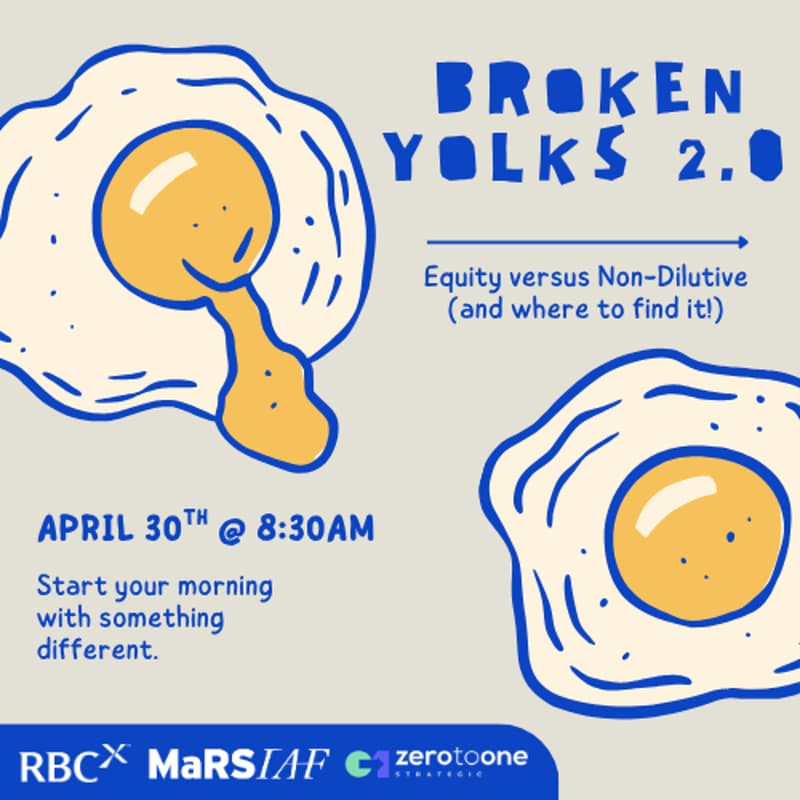

Broken Yolks 2.0: Fry it Yourself or Bring Home the Bacon?
Broken Yolks is a breakfast conversation about the parts of building and investing that usually get edited out. On the menu this month: a focus on one of the toughest founder decisions: whether to bootstrap, raise venture capital, or navigate a path in between.
Instead of polished narratives or one-size-fits-all advice, this event gets into the real decision-making behind funding a company. Founders and VCs will unpack the tension between staying lean and taking on capital: what drives the choice, what gets overlooked, and how those decisions shape everything from growth to control.
We’ll also be joined by specialists from Zero to One, who will share practical insights on how, where, and when to access non-dilutive capital in the Canadian market, adding another lens to how founders can fund and scale their companies.
MaRS Investment Accelerator Fund is one of Canada's most active early-stage venture capital funds. Deeply committed to Ontario's innovation ecosystem, IAF is a multi-sector fund that provides the capital, mentorship, and networks required to build world-class companies.
RBCx banks, builds, and invests in the innovation ecosystem – backed by the institutional strength and stability of the Royal Bank of Canada (RBC). With specialized financial solutions, portfolio building experience, and a collective of specialists that provide powerful support, we help startups and scaleups unlock growth across every stage of their journey.
Zero to One helps Canadian founders unlock non-dilutive funding to scale, without giving up equity. For companies that are investing in R&D, their founder-focused team can help identify and secure federal and provincial grants, maximize SR&ED claims, and access key innovation incentives, managing the process end-to-end. They focus on turning complex technical and commercial milestones into clear, compelling funding narratives that win approvals. Having secured over $170M in non-dilutive capital for clients, Zero to One manages the administrative burden, improves success rates, and frees founders to focus on building category-defining companies.
Mahshid Yassei is the co-founder and CEO of Tali AI, a clinical operating system powering thousands of clinicians and millions of patient visits across Canada and the U.S. She previously co-founded Evenset, a healthcare software company that built products for organizations ranging from early-stage startups to multi-billion-dollar corporations like Essity and government agencies such as the Public Health Agency of Canada. A computer scientist who started her career in security engineering at BlackBerry, Mahshid holds a Master of Computer Science from McGill University and a Bachelor of Computer Engineering from Sharif University of Technology.