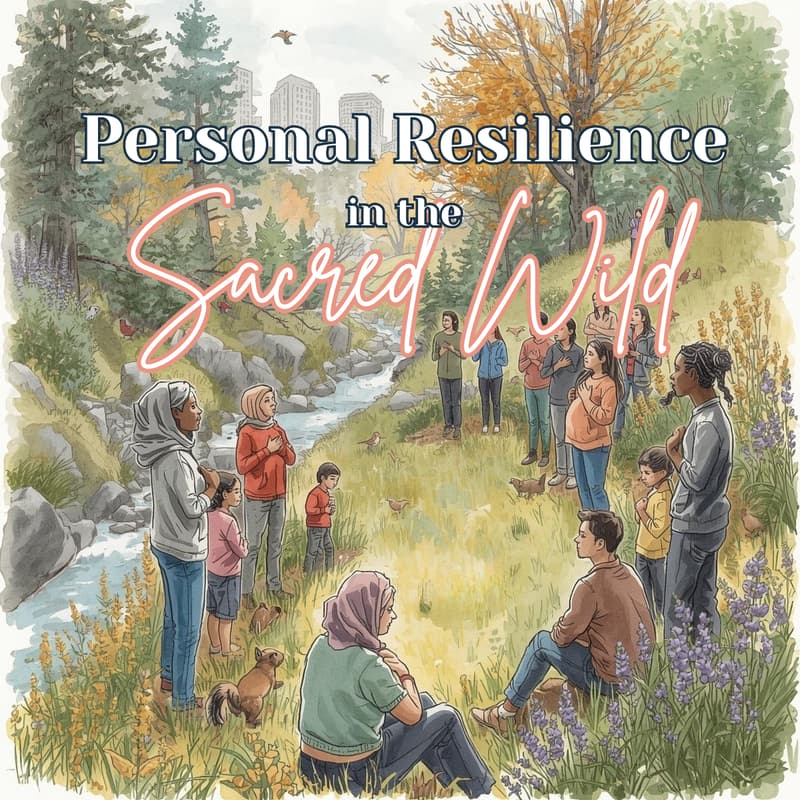
Finding Personal Resilience In the Sacred Wild
This is an experiential and grounding gathering for climate care and self-care.
In the midst of climate change and uncertainty, how do we find resilience, hope, and grounding? Whatever spiritual or faith path you follow, you are welcome to join us in a practice, both ancient and modern, as we explore a new and remembered answer to this question.
Our time together will be an embodied approach to resilience—listening not only with our minds that love to think and theorize our way through problems, but with our whole selves. You’ll be invited to wander the Black Creek ravine, pause, and notice creation as kin – all parts of the ecosystem are holy and connected to each other. Together, we’ll practice ways of tending our inner lives and calming our nervous systems so we can meet the climate crisis with renewed strength, deeper wisdom, and expanded capacity.
Think of our time together as a sacred pause: a chance to refill your cup, share in community, and experience creation not just as scenery, but as a family connected — a constellation of spirit and embodied mycelial network working together to heal ourselves and our planet.
If you're an Edge-Walker, Change-Maker or Hope-Seeker, you will feel right at home!
Curious about what actually is a Wild Church? It’s a growing global movement of family-friendly communities who step outside traditional walls to reconnect body, spirit, and earth. It's rooted in ancient practices and heavily influenced by Celtic Christianity, yet it's not bound by religion. Wild Church gatherings weave ritual, creativity, breathwork, community and experiential practices with the language of wind, water, insects, animals, soil and trees.
Your host, Sarah Peel, has been leading the Lynde Creek Wild Church in Whitby since 2022. She's been active and working in sustainability with organizations such as LEAF, Fashion Takes Action, TRCA, the Toronto District School Board, and the High Park Nature Centre for over 25 years. She's an alumni of York University Faculty of Environmental Studies and OISE at University of Toronto.