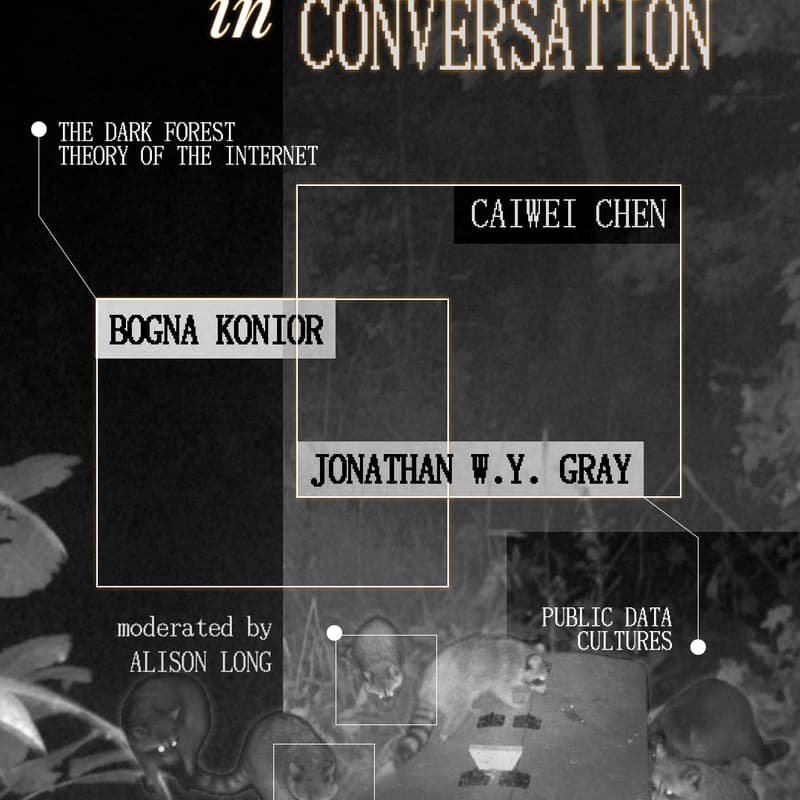

In Conversation w. Bogna Konoir and Jonathan W. Y. Gray
Hosted online by Accent Sisters, this book talk brings together Bogna Konior and Jonathan W. Y. Gray to discuss their new books, The Dark Forest Theory of the Internet and Public Data Cultures, in conversation with MIT Technology Review journalist Caiwei Chen.
Books in Discussion
The Dark Forest Theory of the Internet by Bogna Konior
The Dark Forest Theory of the Internet investigates how intelligence–human and artificial–manifests under conditions of secrecy, hostility, and concealment.
Departing from Chinese science fiction writer Liu Cixin’s dark forest theory, which frames the universe as a hostile terrain filled with predators where transparent communication is foolish and dangerous, the book portrays the internet as a cosmic war machine, teeming with existential tension, nascent AI cults, and deceptive superintelligences. It maps a digital world in which deception is safety, silence is strategy, and new forms of intelligence emerge through obfuscation.
Against decades of writing that moralizes or diagnoses online life, this book suggests a colder thesis: that intelligence itself is mutating under pressure, learning to hide, mislead, and manipulate. Humans are both predator and prey in this digital ecosystem of information exchange whose purpose reverberates on a cosmic scale, weaving us into inescapable patterns of violence. When we break with the ideals of dialogue and open expression, what forms of intelligence and morality survive in their absence? Intelligence does not reward the loudest voice, but the most secretive presence. The future belongs to the quietest signal.
Pubic Data Cultures by Jonathan W. Y. Gray
Public Data Cultures explores the practices and cultures of how data is made public in the age of the Internet. Looking beyond familiar narratives of data as a resource to be liberated or protected, this book offers new perspectives on public data as networked cultural material, as medium of participation and as site of transnational politics. To better account for how data makes a difference, the book argues for a more expansive conception of what is involved in making data public. It focuses not just on removing restrictions but also on caring for arrangements involved in making data public in ways that grow shared understanding and solidarity in responding to the many intersecting troubles of our times.
Nurturing critical and creative engagements with data, this book is essential reading for students and scholars of media, science and technology studies and digital humanities, as well as artists, designers, journalists and activists working with data.
Guests:
Jonathan W. Y. Gray (@jwyg) explores the roles of digital data, methods and infrastructures in shaping how we know and live together. He is the author of Public Data Cultures (Polity, 2025). At King’s College London, he is Reader in Critical Infrastructure Studies at the Department of Digital Humanities and Co-Director of the Centre for Digital Culture. He is also co-founder of the Public Data Lab; research associate at the Digital Methods Initiative (University of Amsterdam) and the médialab (Sciences Po, Paris); and has taught with the School for Poetic Computation in NYC. More about his work can be found at jonathangray.org.
Bogna Konior is Assistant Professor of Media Theory at NYU Shanghai. She is the author of The Dark Forest Theory of the Internet (Polity, 2025) and co-editor of Machine Decision is not Final: China, and the History and Future of Artificial Intelligence (Urbanomic, 2025).
Caiwei Chen is a China reporter at MIT Technology Review, where she covers China’s role in the global tech world. She has written about technology, the internet, and culture for publications including Wired, Protocol, South China Morning Post, and Rest of World. She was part of the Chaoyang Trap newsletter and is currently a regular contributor to Pixel Perfect, a Chinese-language podcast about technology and culture. She is based in Brooklyn, New York.