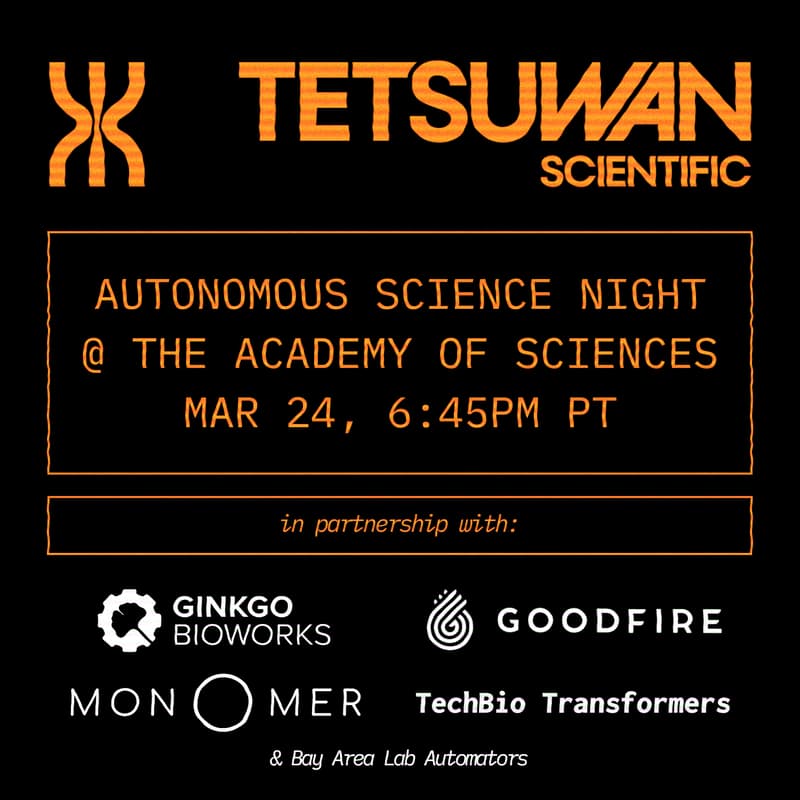
Autonomous Science Night @ The Academy of Sciences
Presented by Tetsuwan, in partnership with Tech Bio Transformers & Bay Area Lab Automators. Join us for four ten-minute talks starting at 7:15 (doors open at 6:45), a reception complete with drinks & theremin music, and to enjoy an evening at the beautiful venue that is the California Academy of Sciences.
At the genesis of artificial intelligence, the field's minds were split into two camps. The symbolist camp, led by Marvin Minsky, contended that intelligence was the manipulation of rules and logic, and that a mind was a machine for processing symbols. The neural network camp, led by Frank Rosenblatt, argued the that intelligence emerged from the structure of the brain itself. Early innings heavily favored the symbolists. The publication of Minsky's "Perceptrons" led to the near extinction of neural network research. Rosenblatt would tragically pass away in an boating accident two years later, on his 43rd birthday. An interest that had once captivated the field was starved of funding and talent for over a decade. It was not until the mid-80s that the work of Hinton, Rumelhart, and others (on backprop) reopened the door the on neural network and not until 2012 when it was finally vindicated by AlexNet's ILSVRC performance.
Few modern inventions have been as consequential. The neural network, a product of our understanding of our biology, now stands to help us further decipher it. OpenAI, Anthropic, and Google have directed resources to leveraging the neural network and its progeny to automate the discovery of new knowledge, as have the United States, Canada, & the United Kingdom. Its advocates believe that automated science could decode the mechanisms of diseases that have confounded us for millennia, discover materials with properties that no human researcher would think to look for, and ultimately reshape the process of how humanity generates knowledge.
But where does this weary traveller, the neural network, really stand in its journey to understanding the biology of the organic lifeforms responsible for its inception? It cannot pipette, it cannot culture, it cannot run experiments and generate data. The physical world remains just outside its reach. It struggles with creativity, an attribute to the meaningful generation of new hypotheses. What is the fate of the neural network in this journey? Will it succumb to these challenges or overcome them? At a time when our scientific institutions is eroded as quickly as excitement around new tools accelerates, what is the fate of scientific discovery itself?
On March 24th, hear from some of the groups operating at the frontier of autonomous science: Ginkgo, Goodfire, Monomer Bio, and Tetsuwan Scientific. Thank you to our speakers, as well as our community partners at Bay Area Lab Automators and Tech Bio Transformers. Read more about our speakers here:
About Ginkgo & Will Serber, PhD
Modular hardware, autonomous labs, and AI-driven science, oh my! In this talk, Will Serber, VP of Automation at Ginkgo Bioworks, will talk about the latest developments and cutting-edge experiments Ginkgo is conducting with OpenAI, with the Department of Energy, and in its own labs.
About Goodfire & Mark Bissell
Mark is a member of the technical staff at Goodfire, an AI research company building the tools and techniques to understand, learn from, and design AI systems. Goodfire partners with organizations like Mayo Clinic and Arc Institute to uncover the latent knowledge inside AI models, enabling scientific discovery, hypothesis generation, and model debugging + improvement. Mark's talk will cover how Goodfire's platform acts as an in-silico R&D lab that brings together data, models, and agents equipped with frontier interpretability tools to make the most of the intelligence inside scientific foundation models.
About Tetsuwan & Alex Rolfness
Tetsuwan is building a compiler for scientific experimentation. Its chief goal is to bridge the gap between researchers, models, and automated research platforms, to achieve the development of a cloud lab. A cloud lab would allow any researcher or model to gain access to an automated lab over the internet.
About Monomer Bio & Jimmy Sastra, PhD
Jimmy is the CEO of Monomer Bio and has spent over two decades working at the intersection of robotics, automation, and biotechnology. He previously helped scale automated biology at Transcriptic and conducted robotics research at Willow Garage and the UPenn GRASP Lab. In his talk, “Scientific agents run autonomous workcells to grow cells and complex tissues,” he explores how cell culture remains a largely manual process that depends on tacit expert knowledge that is difficult to document or transfer, creating risk for organizations when critical expertise resides with a small number of scientists and can effectively disappear if they leave the company. He presents autonomous cell biology as a new paradigm where scientific agents and robotic workcells learn continuously with humans in the loop to grow and annotate tissues, enabling faster exploration of biological solution spaces, more consistent tissue growth, and reduced biological noise.