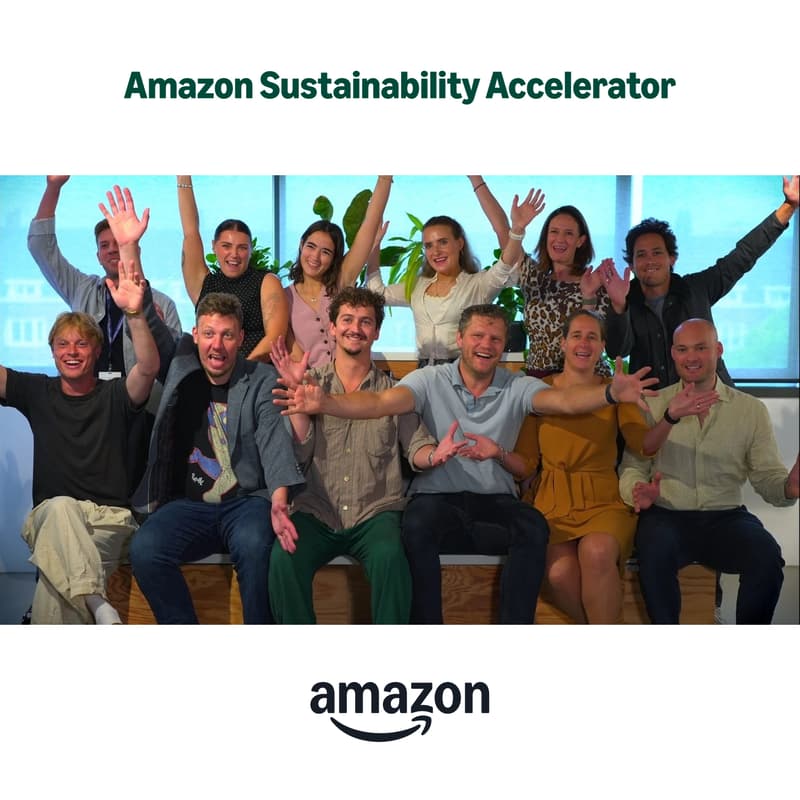

2026 Amazon Sustainability Accelerator Demo Day
Join our fifth Amazon Sustainability Accelerator Demo Day — an afternoon of startup pitches and networking with investors and founders. Nine startups will take the stage to share their responsible consumer products they have built for millions of customers.
Since 2022, the Accelerator has supported more than 40 startups. This year's cohort spans personal care, food and drink, materials innovation, and circular design. Selected from various applicants and shaped by a nine-week programme.
Whether you are an investor, an industry expert, or a sustainability champion, this is your chance to connect, celebrate, and be inspired.
---------------------------------------------------------------
Date: Tuesday 28 July 2026
Time: 2:00 PM – 6:00 PM
Venue: Amazon UK Headquarters (LHR16) 1 Principal Place, Worship Street, London EC2A 2FA
Agenda:
2:00 – 3:00 PM Arrivals & Refreshments
3:00 – 5:00 PM Startup Pitches and Guest Speaker - Laura Harnett from Seep
5:00 – 6:00 PM Drinks & Networking
Please arrive by 2:30 PM to be seated by 3:00 PM, late arrivals may not be admitted.
---------------------------------------------------------------
This year's cohort of consumer-focused sustainable startups:
Rollr (London, UK): A refillable roll-on deodorant in a glass bottle designed to be kept and reused. Customers refill the bottle at home by adding a concentrated powder sachet to water: it’s less material, less weight, less waste. Rollr won Best in Show at The Dieline Awards in 2025.
Luna Daily (London, UK): Luna Daily makes body care products designed for the whole body — head to toe, including intimate areas. Their hero product, the "Everywhere Spray-To-Wipe," is a full body cleansing spray that replaces single-use disposable wipes. One bottle replaces up to 250 wipes, and to date Luna Daily has diverted more than 50 million wipes from landfill.
Clara's Corner Organics (West Wycombe, UK): Clara's Corner Organics grows and formulates organic skincare products for children. For its packaging, the brand uses plant-based Shellworks Vivomer packaging that biodegrades without producing microplastics.
BRØL (Copenhagen, Denmark): An organic and certified B Corp brewery transforms surplus ingredients — including wheat bran — into beer, ready-to-drink cocktails, soft drinks, and non-alcoholic beverages. To date, BRØL has given more than 100 tons of surplus ingredients a second chance.
Coffee Based (Gorinchem, Netherlands): Coffee Based turns coffee waste — used grounds and silverskin, the thin husk that comes off beans during roasting— into premium, reusable cups that comply with EU food safety regulations, replacing single-use and fossil-plastic alternatives with an estimated 73 percent CO₂ reduction compared to paper cups over four years. They have already sold over one million Coffee Based products.
Wasted ApS (Copenhagen, Denmark) — This Copenhagen-based company rescues surplus bread — loaves destined for the bin — and turns it into everyday food products, including pasta made from 25 percent bread waste. To date, Wasted has upcycled approximately 10 tonnes of surplus bread, the equivalent of 345,000 slices. The brand is endorsed by three-Michelin-star chef Massimo Bottura and has been nominated for the Earthshot Prize 2026.
GLORIAH (Edinburgh, UK) — GLORIAH makes a natural moisturiser for vaginal dryness — sold in a glass bottle you keep and refill instead of throwing away. Since launching in 2021, that simple switch has prevented over 120,000 pieces of plastic from being binned.
Nlcomp (Monfalcone, Italy) — The team from nlcomp developed rComposite®, a recyclable composite material for high-performance sports equipment including surfboards, helmets, and ski gear. The material delivers a lower carbon footprint than conventional thermoset composites and is fully recyclable at end of life — replacing fibreglass that currently ends up in landfill. nlcomp has won nine international awards, including the World Sailing Technology Award.
Circular grain (Munich, Germany) — The all-female founding team of Technical University of Munich alumni who have developed Tremi: a milk alternative made from brewer's spent grain, a by-product of beer production that is often used as animal feed. Tremi delivers on average three times more protein and six times less sugar than oat milk, while requiring no new crops or agricultural land. It has a significantly lower CO₂ footprint, land use, and water use than both oat milk and dairy.
---------------------------------------------------------------
Spaces are limited. Whether you are a returning guest or joining for the first time, please register now to secure a spot.
Please note we will be filming at the event. If your registration is approved and you have concerns, please contact us at sustainabilityaccelerator@amazon.com or let us know on the day.