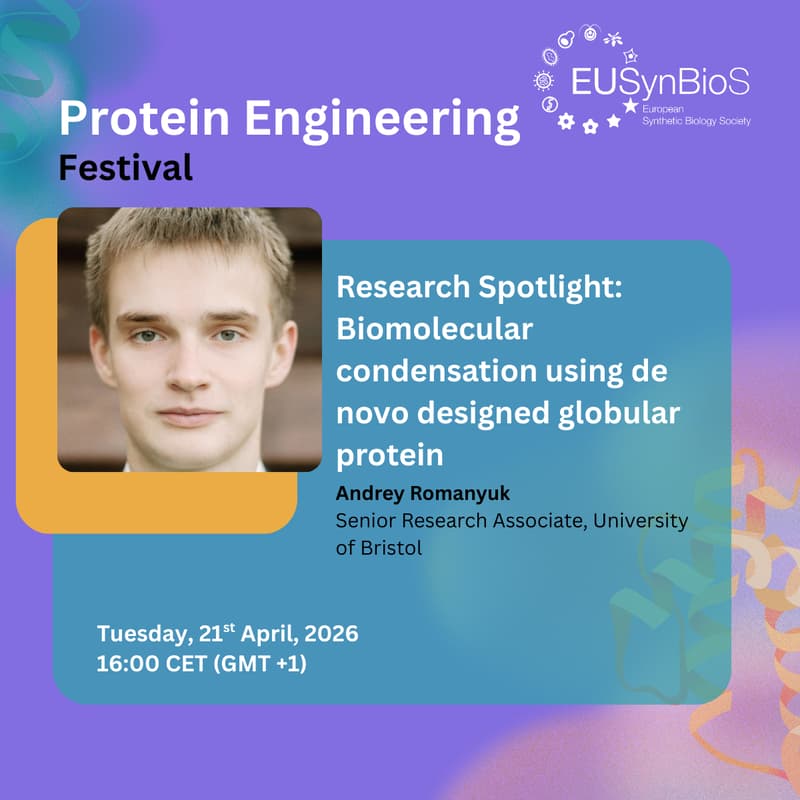

Research Spotlight: Biomolecular condensation using de novo designed globular protein
This talk explores recent advances in de novo protein design to create proteins that can drive biomolecular condensation. While AI-based protein design tools have made significant progress, many functional targets remain challenging to access.
Dr Romanyuk will present work on designing globular proteins with identical amino acid compositions but different surface charge distributions, demonstrating how these differences influence protein–protein interactions and the formation of condensates. By linking these domains, the team engineered proteins capable of forming dynamic, liquid-like condensates both in vitro and inside living cells.
The talk will highlight how these designed systems can be functionalised, enabling direct visualisation and manipulation within cells. This work showcases how de novo protein design can be used to engineer new forms of intracellular organisation, opening up exciting possibilities in synthetic biology and cellular engineering.
Link to paper: https://www.biorxiv.org/content/10.64898/2025.12.19.695468v1
About the speaker
Andrey Romanyuk is a Senior Research Associate at the University of Bristol, working at the interface of de novo protein design, synthetic biology, and soft matter biophysics. His research focuses on designing novel proteins from scratch and understanding how they self-assemble to form complex biological systems, including membraneless organelles.
He is particularly interested in biomolecular condensation and protein self-assembly, exploring how engineered proteins can be used to create new functional structures inside cells. His work contributes to advancing bottom-up synthetic biology, with applications in cellular engineering and biotechnology.
Dr Romanyuk is part of the Bristol BioDesign Institute and has contributed to research demonstrating how de novo designed proteins can assemble into functional compartments within living systems.