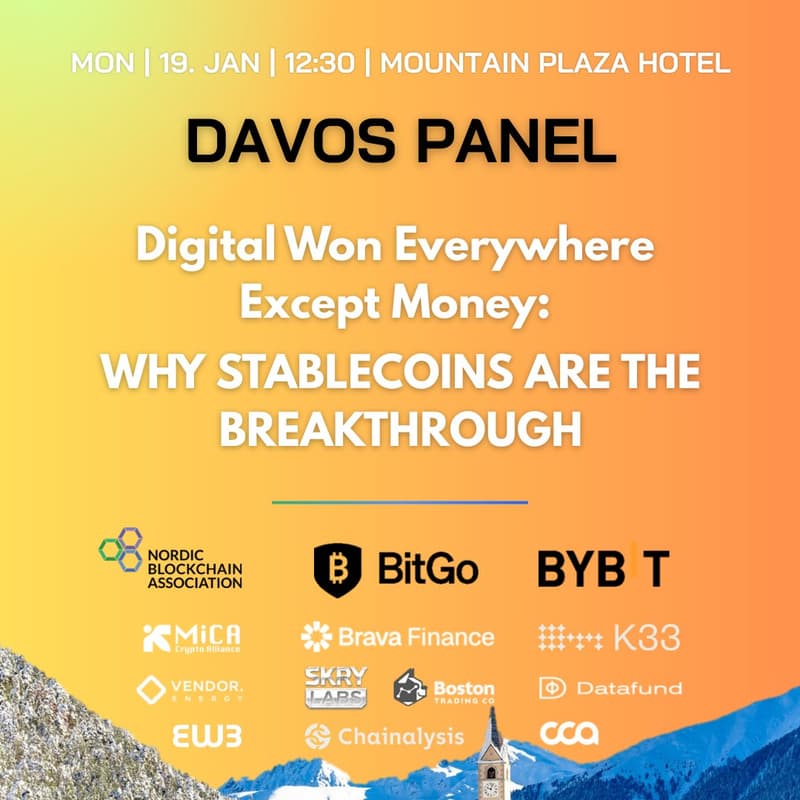

PANEL - Digital Won Everywhere Except Money: Why Stablecoins Are the Breakthrough
Session Overview
PANEL - Digital Won Everywhere Except Money: Why Stablecoins Are the Breakthrough
For 30 years, software has systematically dismantled the cost, friction, and latency of every major system of coordination—media, commerce, logistics, communications. Money is the exception. Despite a fully digital economy, finance still operates on batch settlement, fragmented ledgers, delayed reconciliation, and jurisdictional silos.
This session explains why money resisted digitisation longer than any other layer—and why that resistance is now collapsing.
Stablecoins are not a new asset class; they are the native digital form of cash.
Always-on, programmable, and globally interoperable, they collapse payments, treasury, savings, and short-term credit into a single financial primitive.
Once money becomes software, capital markets follow.
Tokenised credit and assets enable continuous settlement, real-time risk management, and radically more efficient capital allocation.
This is not a speculative future or a regulatory thought experiment. It is a structural shift already underway, driven by utility, scale, and economics.
The discussion focuses on what changes when money finally digitises—and why this transition will underpin the next phase of global financial infrastructure.
Join Nordic Blockchain Association and Brava Finance for a discussion on the mechanisms of the future of finance - that is already here.
- Clara Guerra - Office for Digital Innovation, Liechtenstein Government
- Stefan Arnold - SAP
- Brett Reeves - Bitgo
- Graham Cooke - Brava Finance
-Jan-Oliver Sell - Qivalis
- Magnus Jones - Nordic Blockchain Association
The Panel is part of the Digital Asset Program at the unDavos Summit and this session will be followed by a related Roundtable:
Beyond MiCA: Stablecoins, Infrastructure & the GENIUS Era
Signup for the Roundtable here: https://luma.com/r9az25rl
Finance & Fintech
Finance and fintech are converging—capital structures are changing, technology is reshaping infrastructure, and competitive dynamics are shifting globally.
The finance track examines how capital moves: venture capital and private equity models, pre-exit liquidity mechanisms creating alternatives to traditional exits, investment structures enabling growth without forcing early sales, and the role of strategic versus financial capital in scaling companies.
The fintech track covers where innovation is happening: digital assets including real-world asset tokenization and blockchain infrastructure, China's digital finance ecosystem and what's replicable elsewhere, global payment systems and cross-border infrastructure, AI in risk assessment and compliance, and regulatory frameworks that enable innovation.
Sessions bring together investors, founders, regulators, and corporate strategists examining what's working, what's changing, and where capital meets technology.