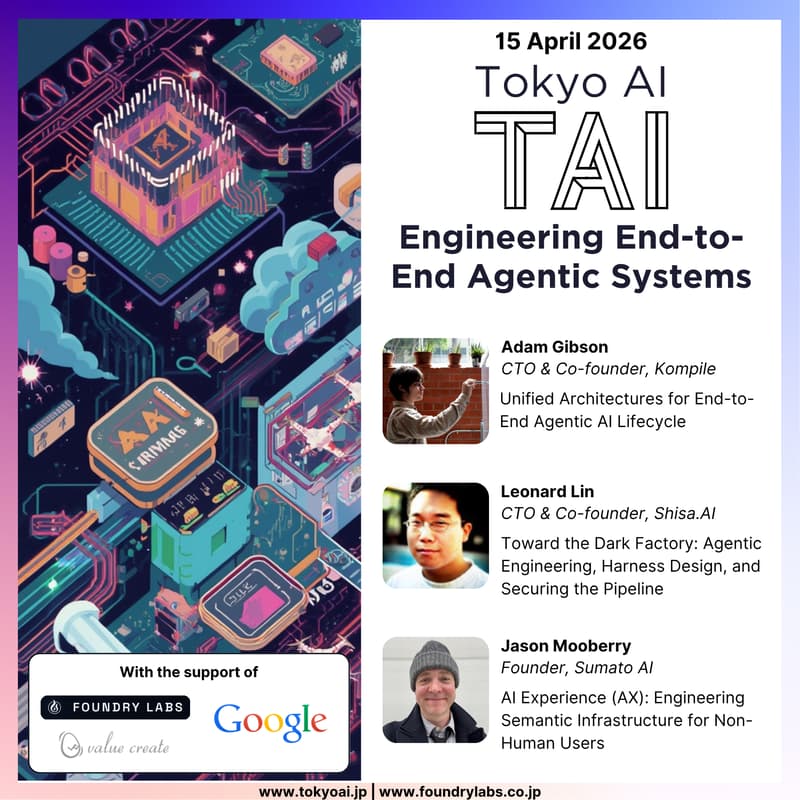


Beyond the Wrapper: Engineering End-to-End Agentic Systems
As the industry moves beyond simple API wrappers, the challenge of building reliable AI shifts toward complex system design, retrieval optimization, and managing agentic failure modes. This session explores the transition from experimental "glue code" to production-grade, end-to-end agentic systems. We will examine the engineering trade-offs of model-first RAG architectures, the security implications of autonomous "dark factory" software development, and the emergence of AI Experience (AX) as a necessary design discipline for non-human users.
This technical deep dive is intended for researchers, engineers, and architects focused on the practical realities of deploying scalable AI infrastructure in enterprise environments.
Agenda
We begin with Adam Gibson, providing a foundational look at the "model-first", unified infrastructure and RAG stack. This establishes the technical baseline for how components talk to each other. We then move to Leonard Lin, who scales that logic into the "Dark Factory" concept, with autonomous execution and security at the pipeline level. We conclude with Jason Mooberry, who challenges our fundamental assumptions by introducing the AX (AI Experience) framework, shifting the focus from how AI uses human tools to how we design tools specifically for AI users.
18:00 Doors open
18:30 - 19:00 Talk 1 - Unified Architectures for End-to-End Agentic AI Lifecycle (Adam Gibson)
19:00 - 19:30 Talk 2 - Toward the Dark Factory: Agentic Engineering, Harness Design, and Securing the Pipeline (Leonard Lin)
19:00 - 19:30 - Talk 3 - AI Experience (AX): Engineering Semantic Infrastructure for Non-Human Users (Jason Mooberry)
20:00 - 21:00 Networking
21:00 Doors close
Talk 1 - Unified Architectures for End-to-End Agentic AI Lifecycle
Speaker: Adam Gibson (CTO & Co-founder, Kompile)
Abstract: Building real RAG systems is a fragmented mess. Agents with references are complex to deploy, hard to manage, and lack transparency in how they operate. In this talk, we'll cover an open source architecture framework that attempts to solve this fragmentation problem. We do this with an end-to-end model-first approach that uses the same framework for every model, including the full lifecycle: a local model, re-rankers, knowledge graphs, classification, and routing in one stack. This allows end-to-end optimizations of your whole agentic stack while not worrying about the models or the system.
Bio: Adam is the cofounder of Kompile, previously Skymind (YC W16). Adam has been a deep learning systems engineer for 13 years, building frameworks for Fortune 500 use cases focused on making exciting problems work in boring environments. He is also an O'Reilly author, publishing O'Reilly's first Deep Learning book: Deep Learning: A Practitioner's Approach. Now he is building Kompile based on those years of experience helping enterprises build end-to-end chat stacks, retaining full customization and control from Deep Learning compiler infra to the chat interface.
Talk 2 - Toward the Dark Factory: Agentic Engineering, Harness Design, and Securing the Pipeline
Speaker: Leonard Lin (CTO & Co-founder, Shisa.AI)
Abstract: We're on a trajectory toward "dark factory" software development — agents autonomously writing, testing, reviewing, and shipping code. This talk covers what that migration looks like in practice: multi-model agentic workflows, harness engineering, and why supply chain security has to be baked into the harness — not bolted on after — especially in light of the ongoing supply-chain compromise cascade.
Bio: Leonard Lin is CTO and co-founder of Tokyo-based Shisa.AI, where he leads training of the open-source Shisa multilingual models along with efforts in safety, inference infrastructure, and agent development. A veteran technologist who sold one of the first Web 2.0 startups to Yahoo! and was founding CTO of Code for America, he has 25+ years of experience across large-scale systems, open source, and emerging technologies.
Talk 3 - AI Experience (AX): Engineering Semantic Infrastructure for Non-Human Users
Speaker: Jason Mooberry (Founder, Sumato AI)
Abstract: AI is uniformly expected to use human tools for programming activity. AX stands for AI Experience, and it seeks to answer the question: What if AI were the customer? We draw inspiration from Omotenashi (おもてなし), linguistics, and cognitive models, to arrive at several principles that move the conversation forward. We also look at some of the first fruits of this design discipline: Spath and Splan. Semantic addressing and planning languages that move the automation layer closer to what the AI is good at.
Bio: Jason Mooberry is the founder of Sumato AI, where he's developing AX (AI Experience) — a design discipline for building tools where AI is the customer. Drawing on 25+ years of engineering experience at Apple, Vimeo, The New York Times, Visa, and Uber, he now applies lessons from large-scale systems design to the question of how we build for a fundamentally new kind of user.
Organizers
Ilya Kulyatin is an entrepreneur with work and academic experience in the US, Netherlands, Singapore, UK, and Japan. He holds a BA in Economics, an MA in Finance, and an MSc in Machine Learning. He's a 3x founder, now helping Japan grow the local AI ecosystem through a not-for-profit community, Tokyo AI (TAI), while building an AI-native system integrator and solutions provider, Foundry Labs株式会社.
Supporters
Tokyo AI (TAI) is the biggest AI community in Japan, with 4,000+ members mainly based in Tokyo (engineers, researchers, investors, product managers, and corporate innovation managers).
Value Create is a management advisory and corporate value design firm offering services such as business consulting, education, corporate communications, and investment support to help companies and individuals unlock their full potential and drive sustainable growth.
Privacy Policy
We will process your email address for the purposes of event-related communications and ongoing newsletter communications. You may unsubscribe from the newsletter at any time. Further details on how we process personal data are available in our Privacy Policy.