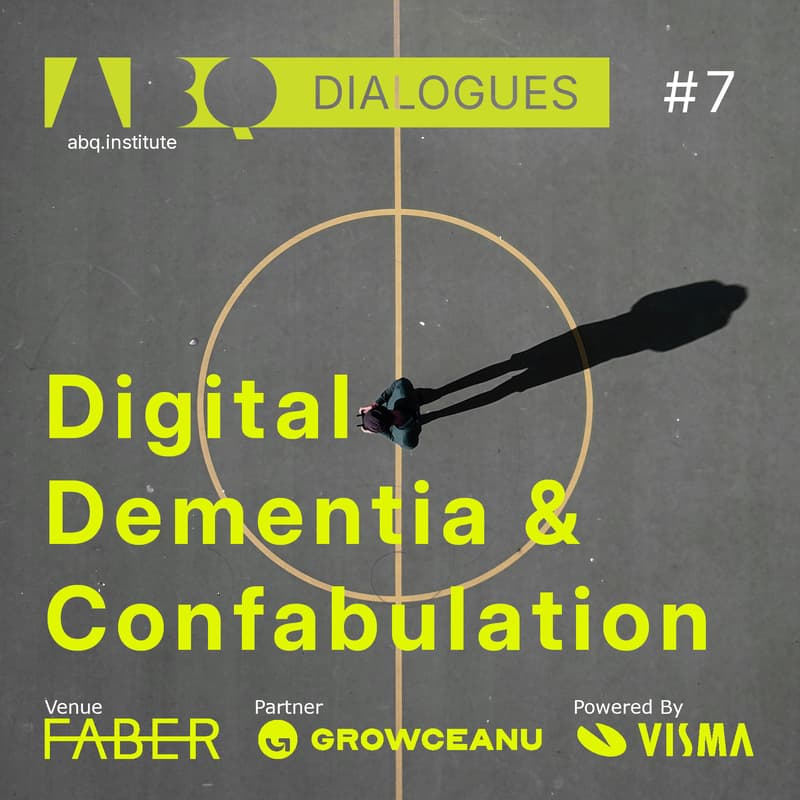

ABQ.Dialogues #7 Digital Dementia & Confabulation
ABQ.Dialogues #7/10 Digital Dementia & Confabulation
When convenience rewires cognition, and intelligence stops being entirely our own.
We live in an age of unprecedented cognitive outsourcing. Memory is offloaded to devices. Attention is harvested by platforms. Meaning is increasingly mediated by feeds, algorithms, and now AI systems that can generate fluent nonsense with total confidence.
What begins as convenience can end as dependency.
At ABQ.Dialogues #7, we open a necessary conversation about the psychological, developmental, social, and civic costs of digital life. This is not a nostalgic critique of technology. It is a serious exploration of what happens when human beings, families, schools, and communities are immersed in systems designed to capture attention, optimize engagement, and increasingly shape perception itself.
“Digital dementia” names the erosion of memory, focus, reflection, and cognitive autonomy in an always-on environment. “Confabulation” points to another emerging risk: the normalization of false coherence — from AI hallucinations to algorithmically amplified distortions, from shallow certainty to collective confusion.
This session is about how digital life is changing not only what we do, but how we think, relate, learn, trust, and raise the next generation.
Why now: the cognitive and social cost of permanent connection
The digital era has delivered extraordinary access, speed, and coordination. But it has also introduced a new layer of fragility into everyday life.
We are seeing the rise of a culture shaped by:
fragmented attention and compulsive stimulation
dependence on devices for memory, orientation, and decision-making
social media habits that reward reaction over reflection
children developing inside systems built for engagement, not education
blurred boundaries between truth, persuasion, fabrication, and performance
AI tools that can assist intelligence, but also simulate it
This is no longer only a technology issue. It is a health issue, an education issue, a parenting issue, a community issue, and ultimately a societal issue.
The real question is not whether digital systems are powerful. It is whether we still have the cultural, cognitive, and ethical capacity to remain humanly in command of them.
What we’ll explore
Digital dementia: what happens when memory, concentration, and deep thinking are continuously displaced by digital convenience
Addiction by design: how platforms, notifications, feeds, and reward loops shape behavior and dependency
Children and education: what constant digital exposure means for learning, imagination, emotional regulation, and developmental health
Confabulation: how plausible falsehoods, synthetic certainty, and machine-generated errors affect trust and judgment in humans
Social trust and shared reality: what happens to communities when attention is fragmented and truth becomes unstable
Identity and mental health: how digital environments affect anxiety, loneliness, self-image, and social belonging
The family challenge: how parents, educators, and communities can respond without either panic or surrender
A healthier digital future: what kinds of norms, habits, institutions, and design principles could restore balance
Who should attend
parents trying to navigate screen exposure, attention, and child development
teachers, school leaders, and education innovators
psychologists, therapists, and health professionals
founders, technologists, and product builders
students and young professionals living inside digital-first culture
community leaders, policymakers, and civic thinkers
anyone asking: what is all this doing to us, and what kind of society are we becoming?
The big question
If we continue to optimize for speed, stimulation, convenience, and synthetic intelligence, what happens to memory, discernment, patience, human presence, and the ability to live meaningfully together?
This dialogue is not about rejecting technology. It is about recovering agency.
Because if we do not consciously shape our digital environment, it will shape us by default.
And the deeper risk is not only that machines become more intelligent.
It is that humans become less attentive, less grounded, less relational, and less capable of distinguishing what is real.
Join ABQ.Dialogues #7 and help us examine one of the defining tensions of our time: how to benefit from digital progress without sacrificing cognition, sanity, education, and community in the process.
Reading Recommendations (more to come)
Digital Delusion by Jared C. Horvath
Ask and upvote questions to help shape the speakers’ focus.
https://www.menti.com/alon3wzjsunc
ABQ.Dialogues #7/10 Speakers:
Monica Diaconu, co-founder Babel Școală și Liceu
Mircea Dragu, psychologist trained in cognitive‑behavioral psychotherapy
Dr Marinela Hurmuz, senior psychiatrist, psychotherapy, medical doctor
Prof Dr Crisanta-Alina Mazilescu, university professor, double PhD
Dr Bogdan Nadolu, associate professor, psyho-sociology
What’s needed?
a clearer public language for discussing digital harm without falling into clichés or moral panic
better models for children’s digital hygiene, attention protection, and cognitively healthy education
stronger family and school practices around screens, focus, sleep, and real-world interaction
more responsible AI usage, especially where synthetic outputs can distort trust and judgment
healthier community norms for dialogue, disagreement, and truth-seeking
product, policy, and design choices that protect human agency rather than exploit cognitive weakness
a broader cultural commitment to rebuilding reflection, presence, memory, and meaningful social connection
About ABQ.Dialogues
The ABQ Dialogues are a human-centric conversation series where diverse voices explore how emerging technologies reshape the fundamental aspects of our lived experience and collective future.
The Dialogues follow ABQ’s main pillars: education, entrepreneurship, and societal impact by bringing together diverse professional voices in a progressive learning journey. We aim to highlight technology’s impact, creating deeper understanding of how AI, Blockchain, Bio-engineering, and Quantum Computing are reshaping our world.
The Dialogues prioritize how these innovations impact the most fundamental aspects of human experience. From healthcare systems and longevity to artistic expression, psychological well-being, social connections, and community faith structures, we explore both current changes and future implications for how we live, work, create, and find meaning. The Dialogues prioritize people over technology, ensuring that human values and needs guide our collective understanding of technological transformation.
Events Format
We propose a monthly conversation series that creates space for dialogue between experts and the public. Each session combines expert presentations with interactive questions and answers, open discussions, and networking opportunities that promote community connections. We believe this format encourages inclusive participation, amplifying voices from multiple sectors and backgrounds while building knowledge progressively across the series.
Our goal is to generate practical insights that serve individuals navigating technological change, community leaders shaping local responses, and organizations implementing new technologies.
After each dialogue, we publish findings for public access, followed by a written article and audio version on our Substack, with human review and refinement from contributors and panelists.
ABQ.Dialogues are a 10-part monthly event series, with 3-hour sessions divided between expert conversations, public interventions, and networking.
If you want, I can now make this more provocative and punchier, in a style that is better optimized for registrations.
Made possible by our partners:
Visma Romania – Main sponsor, leading business software development company
Growceanu – Platform for accessing high-growth investments.
Faber – Host venue, independent cultural center and community hub
The ABQ.Institute Team