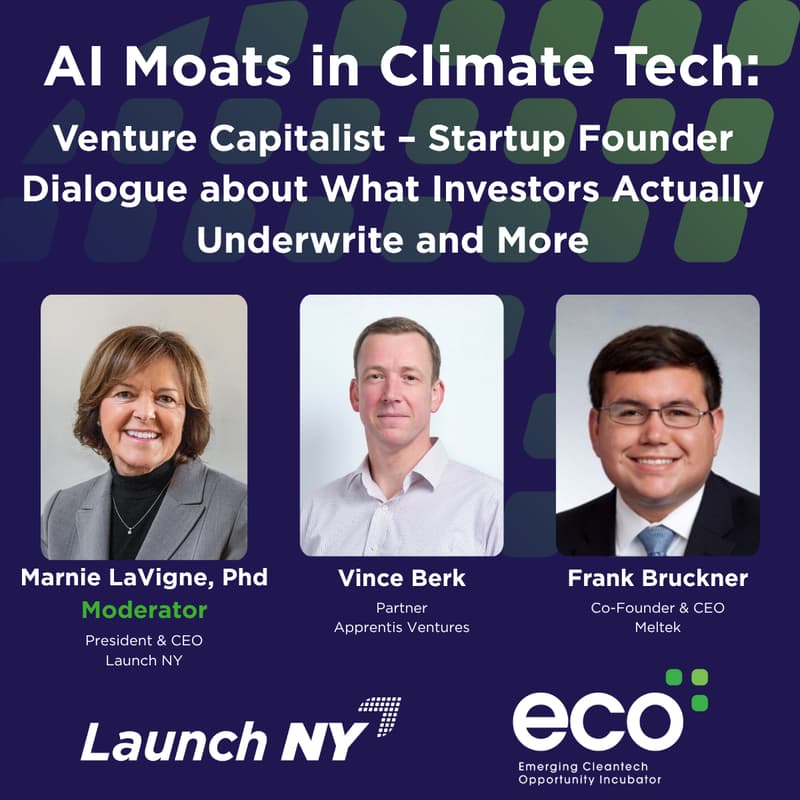

AI Moats in Climate Tech: Venture Capitalist – Startup Founder Dialogue about What Investors Actually Underwrite and More
How Deep Tech Startups Build AI Moats — and why investors are paying attention
Deep tech founders spend years hardening their core technology — novel materials, proprietary processes, physical infrastructure with real switching costs. But when investors sit across the table, they're asking a different question: how does AI compound what you've already built?
This session is for founders in climate tech, biotech, energy, robotics, and advanced manufacturing who want to understand how AI layered on top of hard technology creates the kind of defensibility that VCs actually underwrite.
We'll cover:
Why physical infrastructure is AI's best friend — how proprietary sensors, hardware deployments, and real-world feedback loops generate data no competitor can replicate
The diligence questions you're not ready for — how VCs stress-test AI claims in deep tech: model reproducibility, data provenance, and whether your AI actually touches the core value chain
Using AI to close the efficiency gap — how deep tech founders can deploy AI internally to compete with leaner software-native startups for investor attention
Translating technical depth into investor narrative — moving beyond "we use AI" to articulating compounding feedback loops, switching costs, and long-term data advantages in language that lands in a pitch
Leading this panel will be Marnie LaVigne, PhD, President & CEO, Launch NY.
Speakers
Vince Berk
Founding Partner, Apprentis Ventures
Vince built FlowTraq — a network security analytics company where he applied his PhD research in machine learning to threat detection at enterprise scale. Following its acquisition by Riverbed Technologies, he served as CTO before returning to back early-stage founders. At Apprentis Ventures, he works hands-on with deep tech founders on AI strategy, product architecture, go-to-market, and fundraising. He currently serves on the boards of Harper and Duende.
Frank Bruckner
Co-Founder & CEO, Meltek
Meltek is Con Edison’s top residential Smart Usage Partner, helping over 6,000 customers save on their energy bills this year. Frank leads all aspects of the business, including product development, and has spearheaded the deployment of AI to improve customer experience, operational efficiency, and business development. Frank is deeply familiar with the everyday use cases of AI across internal operations and software development.