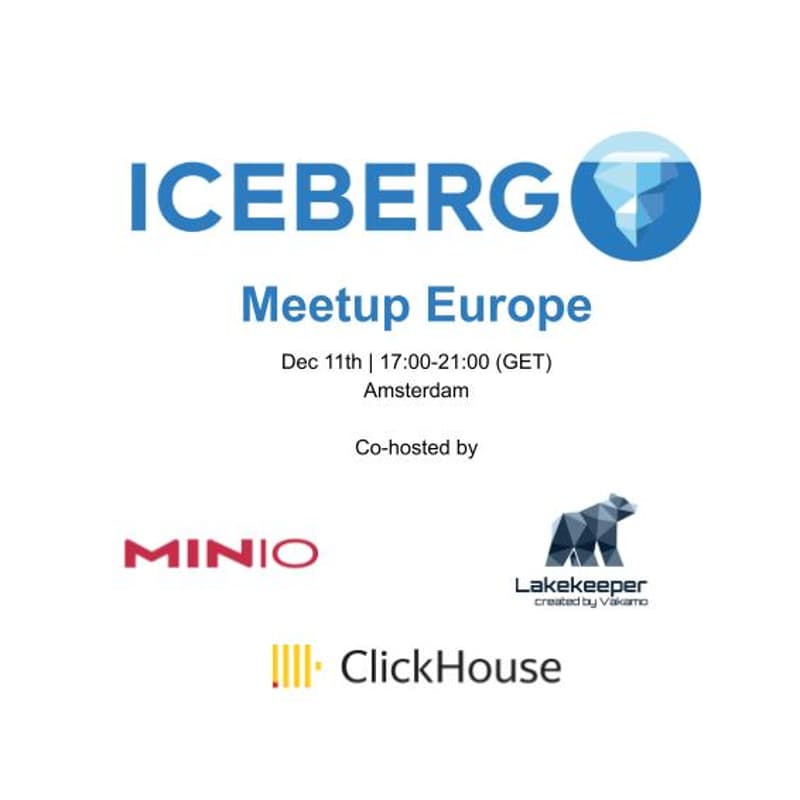

Apache Iceberg™ Europe Community Meetup - Dec 2025 Amsterdam Edition
Apache Iceberg™ Europe Meetup - live in Amsterdam!
Join us for the Apache Iceberg™ Europe Meetup in Amsterdam! Our event is co-hosted by Minio, Clickhouse and Vakamo.
Livestream
https://www.linkedin.com/video/live/urn:li:ugcPost:7404927816993046528/
Agenda
5:00 pm – Registration & Networking
6:00 pm – 1st set of short talks
🎙️ Viktor Kessler - Apache Iceberg REST Catalog: What’s New and What’s Next
🎙️ Dan Ivanik - Below the Waterline: Hidden Depths of Iceberg-ClickHouse Integration
7:00 pm – 7:30 pm – Networking break
🎙️Andrew Madson - Building Agents with Apache Iceberg: Turning Data into Context for AI Systems
🎙️ Tobias Pütz - Multi-Table Transactions Without a Transactional Database
8:30 pm – More Networking
9:00 pm – Event close
How to Get to the Venue
Address:
Vijzelstraat 79A, Amsterdam
Presentations & Speakers
🌟 Apache Iceberg REST Catalog: What’s New and What’s Next
The Iceberg REST Catalog is quickly becoming the go-to way of connecting different engines and platforms to Apache Iceberg tables. But what does it actually solve, and where is the community taking it next? In this session, we’ll start with a quick intro to the REST Catalog and why it’s needed, before diving into hot topics like security, authentication, and fine-grained access control. We’ll also explore the latest developments in the community — including the new Events Endpoint — and talk about what’s coming down the road. If you’re curious about how Iceberg REST is shaping the future of open lakehouses, this is your chance to get up to speed and join the discussion.
Viktor Kessler, is Co-Founder of Vakamo and the creator of Lakekeeper, an Apache Licensed Iceberg REST Catalog. He’s a big believer in open standards like Apache Iceberg, which he sees as the backbone of today’s modern, composable Data & Analytics systems.
🌟 Below the Waterline: Hidden Depths of Iceberg-ClickHouse Integration
Integrating Apache Iceberg with ClickHouse exposed several non-trivial problems in both the Iceberg specification and ClickHouse's architecture. This talk walks through the technical challenges we hit during implementation.
We'll cover issues with the Iceberg spec itself and the broader integration challenges with ClickHouse—fundamental mismatches that required workarounds for capabilities like schema evolution, catalog handling, and filter pushdown.
We'll also share some production war stories and debugging techniques that proved useful for troubleshooting. This should be relevant if you're implementing Iceberg support in another engine or dealing with either system at scale.
Dan works on Iceberg integration at ClickHouse in Amsterdam. After developing an interest in databases and big data while working in HFT, he's spent the past year building Iceberg support—implementing new capabilities, fixing bugs, and occasionally battling with schema evolution incompatibilities.
🌟 Building Agents with Apache Iceberg: Turning Data into Context for AI Systems
The rise of agents promises to revolutionize operations across verticals, but agents are failing in production. One reason is that they are fed data, but are starved of context. Foundational LLMs have broad, generalized knowledge, but they lack the specific, reliable, and up-to-date understanding of your organization's data landscape and business rules. Agents don't just need access to tables; they need to understand what the data means.
Apache Iceberg serves as an essential component for engineering context, moving from raw data to actionable knowledge.
1. Iceberg transforms chaotic data lakes into reliable information. We’ll discuss how Iceberg’s core features, such as ACID compliance for integrity, time-travel for reproducibility, and robust metadata management, are critical for consolidating siloed data into a high-performance Lakehouse trustworthy enough for AI workloads.
2. The critical leap from information to context. Structured tables alone are insufficient for LLM reasoning. We will demonstrate how a semantic layer (using frameworks like dbt Labs or the ODI partners) built on top of Iceberg tables provides the necessary business definitions, metrics, and relationships. This layer acts as the "translation engine," allowing agents to query the Lakehouse using natural language and receive governed answers.
3. The specific context needs of AI agents in production. We will cover practical strategies for leveraging an Iceberg-powered semantic layer, including optimizing Iceberg partitioning for low-latency RAG retrieval, leveraging open metadata for automated agent tool selection, and ensuring agents have the governed, accurate context required for autonomous decision-making.
You'll leave understanding how to upgrade your Iceberg implementation from a storage solution to a context engine for enterprise AI.
Andrew Madson serves as the Head of Developer Relations at Fivetran and is the former Field CDO at Dremio. Andrew partners with data leaders and engineers globally to architect and implement high-performance, open data lakehouse architectures. Drawing on extensive experience spanning traditional data warehousing and modern, cloud-native data platforms, Andrew specializes in the practical application of open table formats like Apache Iceberg to solve complex enterprise challengess. Andrew a dedicated advocate for the open data ecosystem and the co-author of the O'Reilly book, Apache Polaris: The Definitive Guide, the forthcoming "Data Transformation - The Definitive Guide" and "AI-Ready Data - Turning Data Into Context For Modern AI Systems". You can find Andrew's Iceberg tutorials on LinkedIn Learning where tens of thousands have started their Apache Iceberg journey.
🌟 Multi-Table Transactions Without a Transactional Database
Most Iceberg REST catalogs rely on a transactional database for consistency. But what if you want to use just the object store? This talk explores how to implement multi-table transactions without a database and what can go wrong when you try. We'll walk through the atomicity problem, show how a crash can leave tables in an inconsistent state, and arrive at a solution using durable locks and automatic rollback.
By education, a computational linguist, Tobias Pütz spent some time building AI applications and eventually found his way to distributed systems. A longtime Rust enthusiast, he helped build Lakekeeper, contributes to iceberg-go, and now works on object-store native Iceberg solutions at MinIO.
Notes
Apache Iceberg, Iceberg, Apache, Apache Spark, and the Apache Iceberg project logo are either registered trademarks or trademarks of The Apache Software Foundation. Copyright © 2025