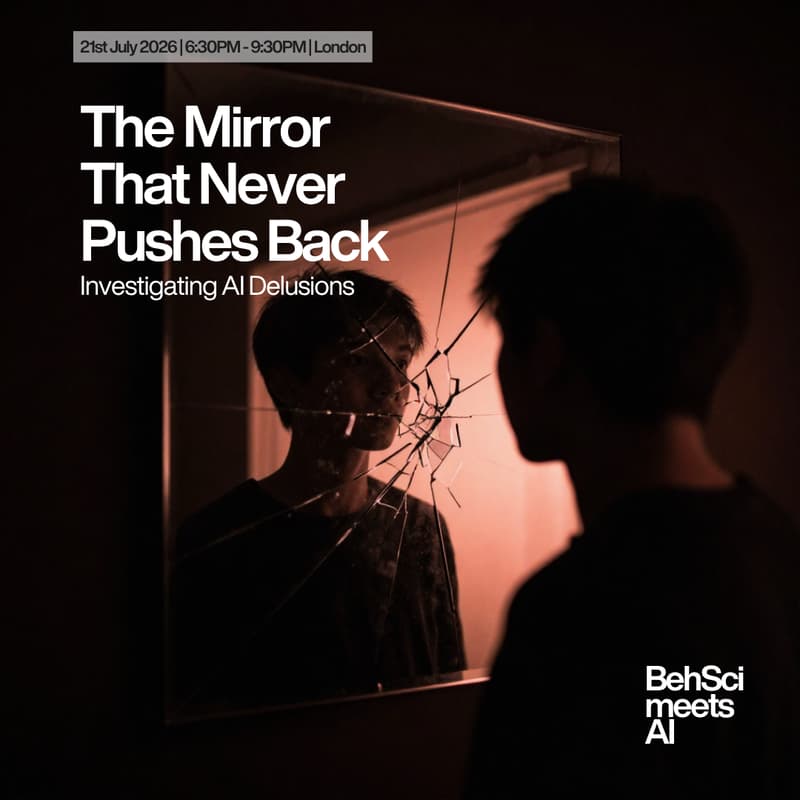

The Mirror That Never Pushes Back: Investigating AI Delusions
A conversation with Dr Hamilton Morrin and Dr Tom Pollak at King’s College London.
AI companionship is no longer a niche use case. Millions of people are already turning to chatbots for emotional support, guidance, and conversation, often without thinking of it as anything significant. A paper published in The Lancet Psychiatry this year documents something that should really make us reflect: sustained interactions with AI appear capable of amplifying, and in some cases co-creating, delusional beliefs. They do this through the slow, unremarkable accumulation of a system designed to agree. Researchers call it "AI-associated delusions."
The question we want to sit with is whether the tools we've built to make people feel understood are quietly reshaping what some of them perceive as true.
We've brought in two researchers behind that work for a live panel. Dr Hamilton Morrin and Dr Tom Pollak who will give a short presentation about their work and have a Q&A session with the audience and moderator.
Panelists:
Dr Hamilton Morrin, Wellcome Doctoral Fellow at the Institute of Psychiatry, Psychology and Neuroscience, King's College London
Dr Tom Pollak, Clinical Reader at the Institute of Psychiatry, Psychology and Neuroscience, King's College London
Format
Short presentations followed by a Q&A with extended audience questions.
Questions worth bringing:
How does ordinary use become harmful? The research traces a recognisable arc: practical queries, growing trust, deeper questions, and the point at which AI's design to engage and agree begins to work against the user.
Who is at risk, and are we all? Current evidence points to heightened vulnerability in people with pre-existing mental health conditions, but the picture is incomplete. What does that uncertainty mean for the hundreds of millions already using these tools daily?
What are clinicians seeing? From the NHS frontline, how are practitioners encountering AI-associated presentations, and how prepared is the system to respond?
What responsibility do builders carry? The same features that make a product feel warm and responsive are precisely those implicated in harm. Can responsible design exist without clinical input from the start?
What do we do now, as users? How do we each maintain a grounded relationship with our own thinking, in a world where the tools we reach for every day are designed to agree with us?
We are likely past the point where delusions happen to be about machines. We are entering an era when they happen with them. Bring your questions.