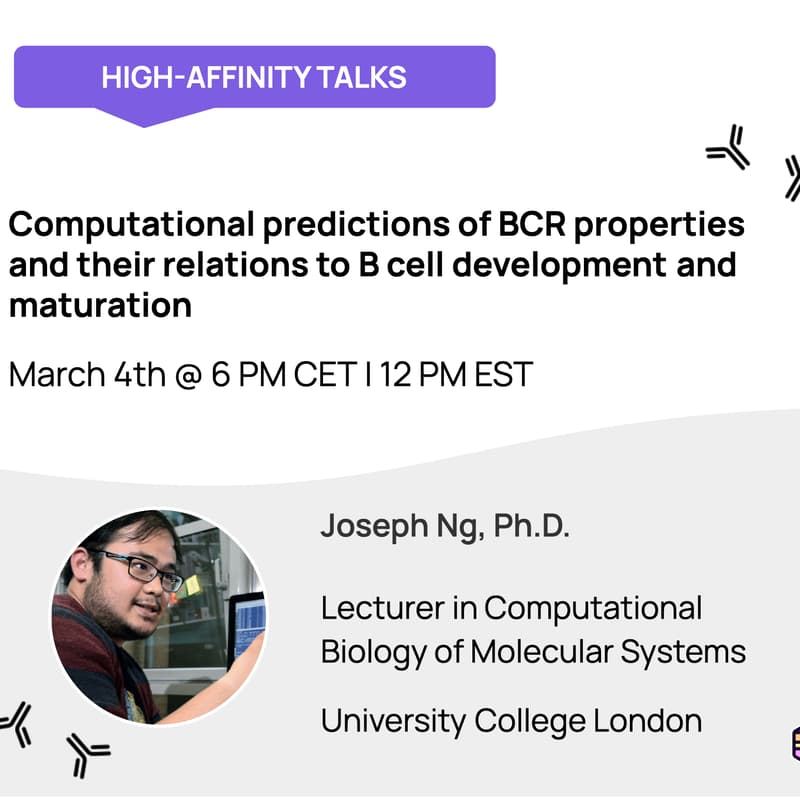

Computational predictions of B cell receptor properties and their relations to B cell development and maturation
The development of compatible heavy (H) and light (L) chain pairs is crucial for viable B cell receptor (BCR) signalling, and conducive in successful maturation of antibody-producing cells in vivo and the designs of therapeutic antibodies. In this talk our speaker will give an overview of computational methods we develop towards predicting these BCR properties, and relating them to the trajectories of B cell development and maturation.
We'll dive into ImmunoMatch, a machine-learning framework we trained on paired H and L sequences from human B cells to identify molecular features underlying chain compatibility, and outline strategies we used towards validating the importance of chain pairing propensity in B cell development.
We will also discuss other computational methods we developed, which harness high-throughput profiling of BCRs and B cell transcriptomes towards describing the dynamics of B cell maturation in health and disease.
Bio: Joseph Ng is a Lecturer and Group Leader at the Research Department of Structural & Molecular Biology in University College London (UCL) Division of Biosciences. Joseph was born and raised in Hong Kong. For his undergraduate degree he studied Biomedical Sciences at the University of Hong Kong (HKU). Towards the end of his undergraduate education he pivoted to computational biology, and did his PhD at King’s College London with the support from the Croucher Foundation from Hong Kong, followed by post-doctoral research at King’s and then at UCL. From January 2026 onwards he leads the Cross-scale Interpretable Omics Laboratory at UCL Structural & Molecular Biology. Joseph's special interests lie in computational immunology (specifically the diversity of antibody repertoire, and characterising immunoglobulin sequence features and transitions in large-scale molecular profiles of B cells), and more broadly in innovative Artificial Intelligence approaches to unravel novel molecular mechanisms of antibody immunity and more general biological problems.