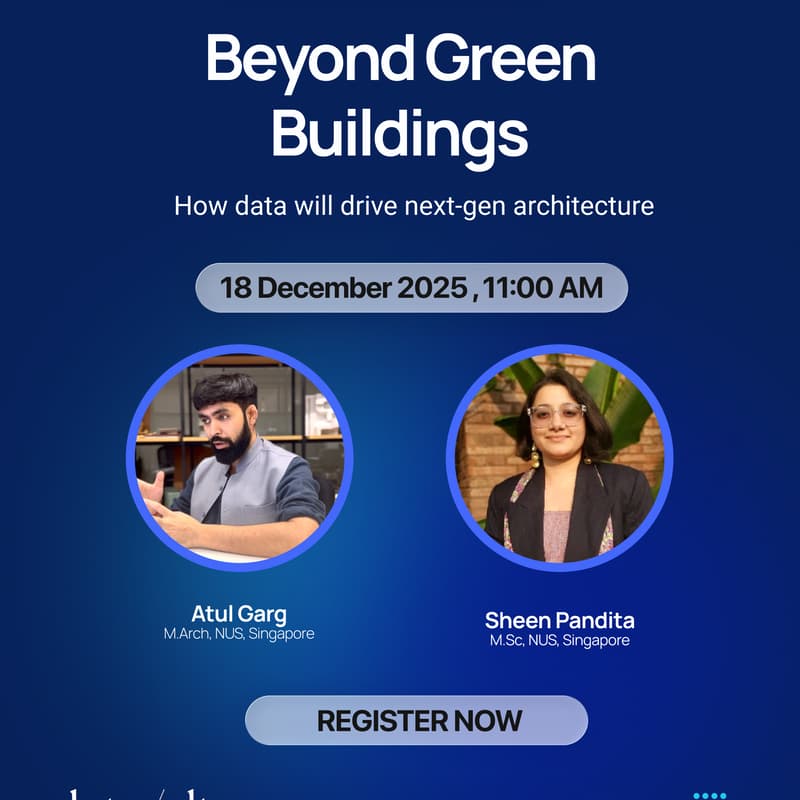
Beyond Green Buildings: How data will drive next-gen architecture
Architecture is entering a new era—one where material choices, form, and aesthetics are only half the story. The buildings of the future will be measured, monitored, and continuously improved through data, unlocking levels of performance that sustainability alone cannot achieve.
In this 40-minute session, architect-technologist Atul Garg (Data Alt Dynamics, ex-NUS Research Associate) and sustainability strategist Sheen Pandita (NUS, Climate & Low-Carbon Specialist) will decode how India’s built environment can move beyond green ratings and adopt data-driven operational intelligence.
Whether you’re an architect, developer, facility manager, or sustainability professional, this session will help you understand the next paradigm: architecture that performs like a living system—aware, adaptive, and constantly learning.
What You Will Learn (Breakdown of 40 Minutes)
0–5 min | Introduction
5–10 min | Part 1 – How Building Choices Shape Climate Change?(Speaker: Sheen Pandita)
10–15 min | Part 2 – What Defines a Sustainable Building? (Speaker: Sheen Pandita)
15–25 min | Part 3 – Data-Driven Decision Making in Buildings (Speaker: Atul Garg)
25–35 min | Part 4 – Introduction to Digital Twin Systems (Speaker: Atul Garg)
35–40 min | Q&A + Closing
Who Should Attend
Architects & Urban Designers
Developers & Builders
Sustainability Consultants (GRIHA, LEED, ECBC)
Factory Owners & Facility Managers
Real Estate Investors
Government & Smart City Professionals
Students interested in building technology
Speakers
Atul Garg
Architect-Technologist | Director, Data Alt Dynamics
Ex–Research Associate, National University of Singapore
Specializing in digital twin systems, building performance, and data-driven operations
Sheen Pandita
Sustainability & Climate Policy Professional
Independent Consultant, Asia Low-Carbon Building Transition Project
Former TERI researcher specializing in thermal comfort, resilience, and low-carbon design
Key Takeaway
This is not a talk on green design.
It’s a roadmap to the next 20 years of architecture:
Buildings that measure themselves.
Buildings that improve themselves.