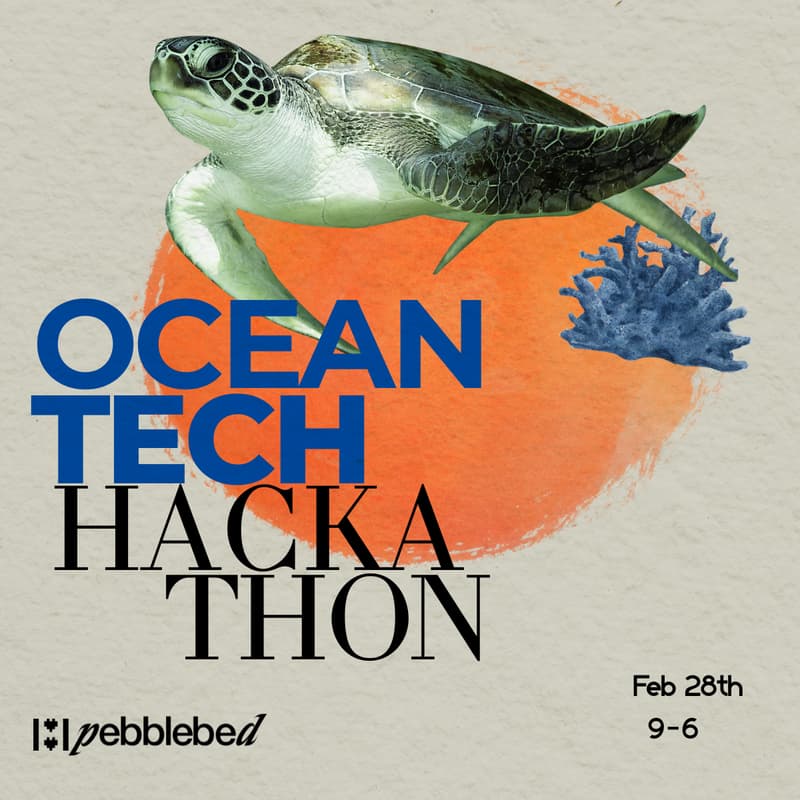


OceanTech Hackathon
What happens when AI engineers meet marine biologists?
Most technical builders care about climate but rarely work alongside marine biologists, ocean policy experts, or communities dealing with coastal flooding. Most ocean hackathons stay abstract because teams lack domain context.
This event is different.
We're deliberately mixing technical builders with ocean scientists, policy practitioners, and people whose businesses are affected by coastal change. One day of grounding in real ocean constraints, then hacking on AI-powered solutions that could actually work in salt water.
Format: Morning talks from ocean experts → hacking in mixed teams → demos and judging
🔗 Full details: https://www.oceantechhackathon.org
👥 Who Should Join
This works best with a mix:
Technical Builders
AI/ML engineers, developers, data scientists who want to apply tools to real ocean challenges. No ocean expertise required — domain experts will be on your team.
Ocean Domain Experts
Marine biologists, oceanographers, coastal scientists, researchers with deep knowledge of maritime systems. No coding required — technical builders will help prototype your ideas.
Policy & Practitioners
People from ocean nonprofits, climate organizations, coastal resilience programs, or communities affected by sea-level rise and coastal issues.
Ocean Tech Companies
Teams building real maritime infrastructure who want to advise or recruit.
🗓 Schedule (One Day)
9:00 — Check-in
9:30 — Opening ceremony: what we're building toward & logistics
9:45–10:45 — Ocean Talks:
Unlocking the Blue Economy — Where Ocean Innovation Breaks Down Between Vision and Execution
Real-Time Ocean Intelligence — The Data Infrastructure Layer Powering Modern Maritime Decisions
Ana Blanco & Natasha Benjamin — Sequoia of the Sea / Blue Frontier
Scaling Nature-Based Solutions: What’s Holding Kelp Restoration Back
Fabien Lamaison — Plastic Odyssey
From Drone to Shoreline — Operational Gaps in Planning Remote Ocean Cleanup Missions
Hacking begins at 11:00 AM.
3:30 — Hacking ends, submission deadline
4:00–5:00 — Finalists Demos (5 mins demo + 3min Q&A per team)
5:00–6:00 — Judging, Winners announced, Networking
⚙️ Tracks
Teams will choose one of three focused tracks:
🌊 Ocean Cleanup & Coastal Operations — Planning and optimizing real-world ocean cleanup missions.
🌍 Ocean Climate & Environmental Intelligence — Turning ocean and maritime data into deployable climate insights.
⚓ Ocean Infrastructure & Governance Systems — Reducing permitting, coordination, and deployment friction in the blue economy.
Hack Pack: Detailed problem statements and datasets will be shared before the event.
All problem statements are contributed from ocean nonprofits and startups, highlighting real-world problems from:
🏆 Judging
Top 2 teams per track advance to finals.
1 winner per track.
Judges
Matthieu Soulé, Partner & Head of C.Lab @Cathay Innovation
Jack Gallegos, Electrical Lead @Dolphin Labs
Nicole Levin, Platform Lead @Pebblebed
Ami Zou, Founder @Climate Tech Club
Chinmay Ravel, Engineering Leader @Affirm
Judging criteria: https://www.oceantechhackathon.org/judging
🤝 Sponsors & Partners
Venue and lunch sponsored by Pebblebed VC: a seed fund founded by leaders from OpenAI, Facebook AI Research, and Sequoia.
Seaweed drinks sponsored by Aquatheon
Organized by Climate Tech Club, Pebblebed VC, and Justin Guest
Problem Statements contributed by