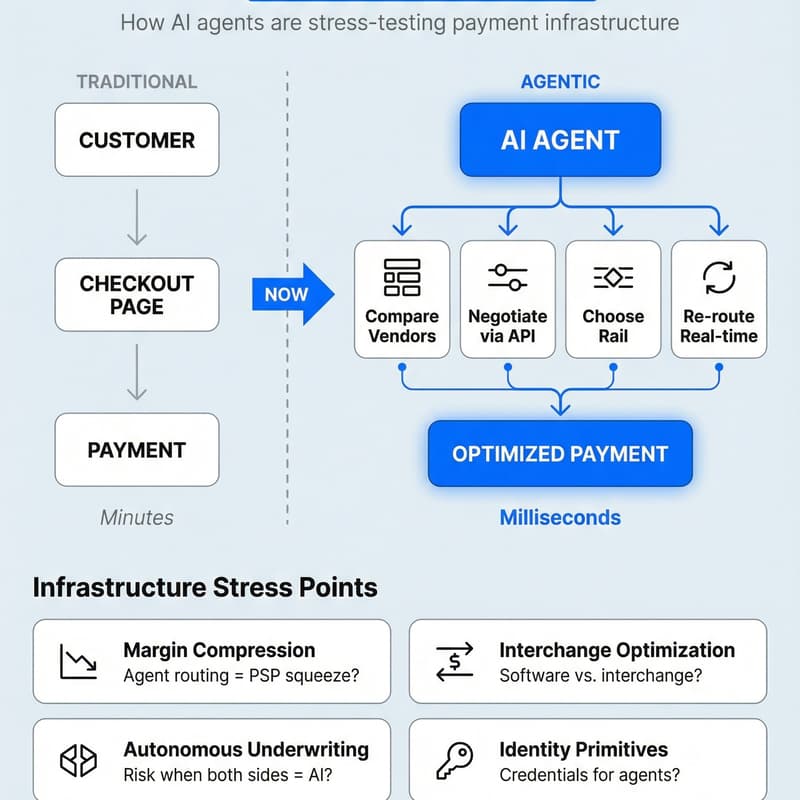

Who Owns the Transaction When AI Initiates It?
Here’s the uncomfortable question:
What happens when your biggest “merchant” isn’t a company —
but an agent?
An AI that can:
Compare vendors in milliseconds
Negotiate pricing via API
Choose the cheapest compliant rail
Split settlement across networks
Re-route in real time based on fees, fraud signals, or liquidity
No checkout page.
No brand loyalty.
No UX nudges.
Just optimization.
The day before Agent Connect, we’re gathering a small group of payments operators to pressure-test what this means at the infrastructure level.
Not vibes.
Not “AI is cool.”
Actual operator questions:
— Does agent-driven routing compress margins across PSPs?
— What happens to interchange when software optimizes against it?
— How do you underwrite risk when both sides of a transaction are autonomous?
— What identity primitives are required for agents to hold credentials or wallets?
— Where do stablecoins outperform card rails in machine-to-machine flows?
— What parts of the current stack become middleware — and what becomes mission-critical?
Because agentic commerce doesn’t remove payments.
It stress-tests it.
This isn’t anti-card.
It isn’t pro-crypto.
It isn’t hype.
It’s a closed-door session for people responsible for uptime, authorization rates, fraud loss, compliance exposure, and margin.
PSPs.
Networks.
Fintech operators.
Risk and identity leaders.
Crypto infra builders.
If you’re quietly running experiments…
Rewriting routing logic…
Or preparing for a world where software pays software…
Be in the room before the main stage conversations start.
Curated.
Operator-heavy.
High trust.
No spectators.
Apply to join.