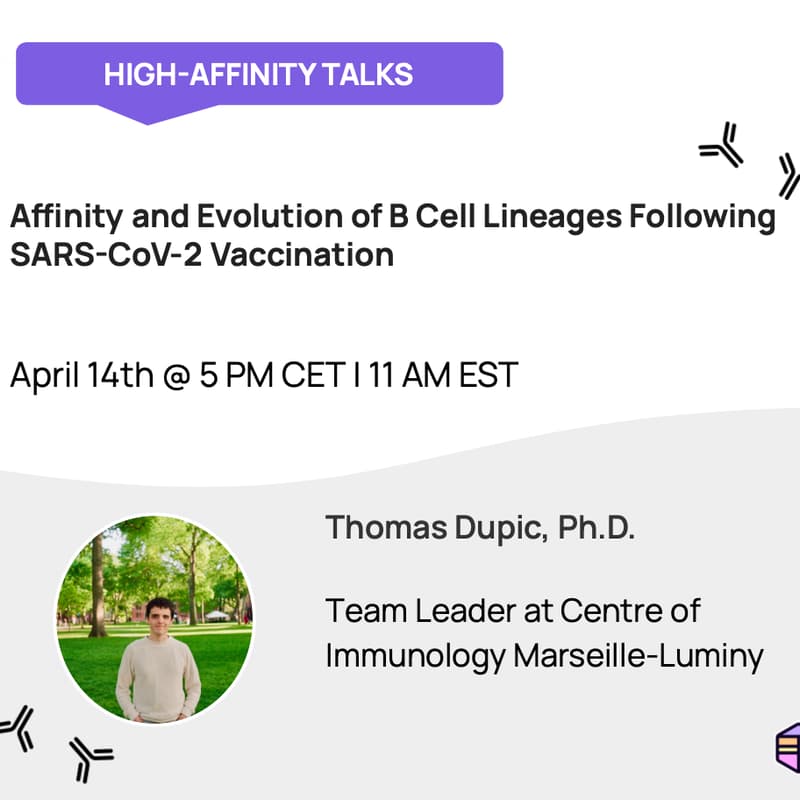

Affinity and Evolution of B Cell Lineages Following SARS-CoV-2 Vaccination
Our next session of High-Affinity Talks will feature Thomas Dupic, Team Leader at CIML, who will present new insights into how B-cell repertoires evolve in response to infection and repeated vaccination.
His team longitudinally tracked the B-cell repertoires of 10 individuals following SARS-CoV-2 infection and subsequent vaccinations. They reconstructed the naïve sequences of a curated set of 10,000 clonal lineages in vitro and measured their affinity for the spike protein receptor-binding domain of SARS-CoV-2.
Their findings reveal that while the overall properties of the repertoire, including diversity, expansion, and V-gene usage, remained stable and similar to healthy individuals, the 'binder' lineages, whose naive sequence is capable of antigen binding, expanded more and had higher mutation rates.
Their evolutionary patterns also differed markedly from non-binders. Among the binders, the high-affinity binder lineages showed the most activity and diversified more across the time points.
They also demonstrate that lineages with identical naive sequences in different individuals evolve in similar ways. This comprehensive dataset of antibody-spike interactions in a real-world setting provides insights into detecting reacting clones within a repertoire and helps us understand how the functional diversity of the naive repertoire shapes the adaptive immune response to vaccination.
This discussion will be hosted and moderated by MiLaboratories, the creators of the leading biologics discovery software.